
Social Media & Evidence FAQs
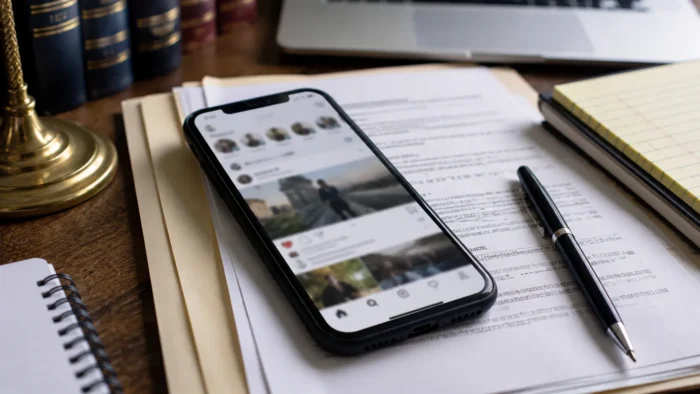
Georgia social media & evidence FAQs on discovery risks, spoliation, private posts & how defense attorneys use your content against your injury claim.
Social Media & Evidence FAQs
Can my social media posts be used against me in a Georgia personal injury lawsuit?
Yes — absolutely and unequivocally. Under O.C.G.A. § 9-11-26(b)(1), Georgia’s civil discovery rules allow opposing counsel to obtain any non-privileged information reasonably calculated to lead to admissible evidence. Social media posts — including photos, check-ins, comments, likes, and even private messages in some circumstances — have all been ordered produced in Georgia personal injury litigation. Insurance defense firms specifically employ social media investigators who monitor platforms like Facebook, Instagram, TikTok, X (formerly Twitter), Snapchat, and LinkedIn for activity inconsistent with claimed injuries. Courts in the Fulton County State Court, DeKalb County State Court, Gwinnett County State Court, and Cobb County State Court have each authorized this type of discovery. The answer is never ambiguous: yes, your posts can and will be used against you.
Should I delete my social media accounts after a Georgia car accident?
No — do not delete your accounts or posts after an accident or after filing a personal injury claim. Deleting social media content after you reasonably anticipate litigation can constitute spoliation of evidence under Georgia law. Georgia courts recognize the spoliation doctrine and may sanction you by instructing the jury to draw an adverse inference — meaning the jury may be told to assume the deleted posts showed exactly what the defense claimed. At minimum, deletion can result in monetary sanctions, discovery sanctions, or even dismissal of your claim in extreme cases. The correct course is to preserve everything, stop posting immediately, and let your attorney at Haug Barron Law Group advise you on what, if anything, must be produced in discovery.
What if my social media is set to “private” — can the defense still get it?
Privacy settings are not legal protection. In Georgia, courts have repeatedly held that the mere fact that a social media account is set to “private” does not shield its contents from discovery if those contents are relevant to the litigation. Under O.C.G.A. § 9-11-34, a party may be required to produce electronically stored information, including private social media data, when relevance is established. The defense can serve a request for production demanding access to your social media profiles, direct messages, and account history — and if you refuse, they can seek a court order compelling production. Treat everything on social media as potentially public in the context of your lawsuit.
Can I post anything supportive after a family member dies in a wrongful death accident in Georgia?
This is one of the most sensitive and important questions families face after a catastrophic loss. Under O.C.G.A. § 51-4-2, the surviving spouse (or, if none, the children) has the right to bring a wrongful death claim for the full value of the deceased’s life. The emotional grief and impact on the family are central components of damages. However, public social media posts by surviving family members — including expressions of grief, gratitude for support, or descriptions of the circumstances of death — can be used by defense attorneys to minimize those damages or to characterize the family as already having achieved “closure.” We strongly advise surviving family members in wrongful death cases to consult with the attorneys at Haug Barron Law Group before posting anything about the case, the accident, or their emotional state.
What type of social media evidence do Georgia personal injury defense attorneys actually look for?
Defense attorneys and insurance investigators search for: (1) photographs or videos showing physical activity inconsistent with claimed injuries; (2) check-ins at locations that contradict mobility limitations; (3) statements about the accident, fault, or health; (4) posts expressing anger or threats toward the defendant; (5) evidence of alcohol or drug use near the time of the incident; (6) posts suggesting the plaintiff returned to work faster than claimed; (7) evidence of travel inconsistent with claimed restrictions; (8) posts where the plaintiff appears happy, healthy, or active during a claimed period of disability; and (9) any mention of the lawsuit, attorney, or settlement that could waive privilege or create inconsistencies. Defense firms in Atlanta, Marietta, Alpharetta, and across Georgia use specialized software that archives social media posts even after they are deleted.
Can my friends’ or family members’ posts about me hurt my Georgia injury claim?
Yes. Content posted by third parties — such as a friend tagging you in a photo or a family member sharing an update about your recovery — is equally discoverable and can be equally damaging. If your friend posts a photo of you at a birthday party two weeks after you claimed you could not leave the house, that photograph is as useful to the defense as one you posted yourself. You should speak with close friends and family immediately after an injury and politely but clearly ask them not to post photos of you, tag your location, or share updates about your activities or health. This is not dishonesty; it is responsible litigation conduct advised by every plaintiff’s personal injury attorney in Georgia.
How long after a Georgia accident should I stay off social media?
You should avoid posting on social media from the moment of the accident until your case is fully resolved — whether by settlement, verdict, or dismissal. Georgia personal injury and wrongful death cases can take one to three years or longer to resolve, particularly in complex cases involving catastrophic injuries, disputed liability, or significant damages. That timeline means you need to maintain social media discipline for the duration. Even after a settlement, many agreements contain confidentiality clauses that prohibit public disclosure of terms. The safest approach is complete suspension of personal social media activity for the life of your case. At Haug Barron Law Group, we counsel every client on this from day one.
Does social media evidence affect my damages in a Georgia personal injury case?
Social media evidence can affect every category of damages in a Georgia personal injury case. Under O.C.G.A. § 51-12-2, a plaintiff is entitled to recover special damages (medical expenses, lost wages, future economic losses) and general damages (pain and suffering, emotional distress, loss of enjoyment of life). Social media posts that contradict your claimed limitations can be used to reduce or eliminate general damages, challenge lost wage claims, and undermine the credibility of your treating physicians’ opinions. In wrongful death cases, posts by the surviving family can affect the “full value of life” calculation. At Haug Barron Law Group, our attorneys understand the full spectrum of damages available in Georgia and work meticulously to protect them from social media attacks.
Can social media evidence be used to prove my case — or only against me?
Social media can cut both ways. In some cases, the defendant’s social media activity can be powerful evidence for the plaintiff. For example, if a truck driver posted on Facebook that he was running behind schedule before a crash that may have caused him to speed, or if a property owner’s employees posted photos showing a dangerous condition, that content can be invaluable. At Haug Barron Law Group, our litigation team proactively investigates defendants’ social media, corporate communications, and online presence as part of our discovery strategy. We are aggressive on both offense and defense when it comes to digital evidence, and this comprehensive approach is part of why we routinely achieve seven- and eight-figure results for our clients.
What should I do if the defense has already found a social media post that could hurt my Georgia injury case?
Do not panic — but do not ignore it either. Contact Haug Barron Law Group immediately. Our attorneys have successfully addressed damaging social media evidence in Georgia courts through context, authentication challenges, relevance objections, and proportionality arguments. We can also work with your medical experts to explain why a single photograph does not define the full scope of a chronic pain condition or disability. Social media posts rarely tell the whole story, and our trial attorneys know how to present your complete medical history and lived experience to a jury. The worst thing you can do is fail to disclose the post to your attorney, attempt to delete it, or address it yourself.
My child was catastrophically injured at school in Georgia. Does social media advice still apply?
Yes, and it applies to both parents and the injured minor. In school injury cases, which may involve claims under O.C.G.A. § 20-2-1000 et seq. and constitutional theories if the school is a public institution (see the Georgia Department of Education), social media posts by parents expressing anger at the school, describing the incident, or posting photos of the child’s injuries can seriously compromise the case. Ante litem notice requirements under O.C.G.A. § 36-33-5 (for municipalities) and O.C.G.A. § 50-21-26 (for state entities) impose strict deadlines that must be met before suit can be filed. Contact Haug Barron Law Group immediately if your child was injured at school in Georgia.
Can I post updates in a private Facebook group after a Georgia accident?
Private Facebook groups are still discoverable. Georgia courts have ordered production of private group posts where relevance is shown. While the threshold for compelling production of private group content may be marginally higher, it is not insurmountable — particularly if other members of the group post screenshots or discuss the content publicly. Treat private groups the same way you treat public posts: say nothing about your accident, your injuries, your health, or your case. The only truly protected communications are privileged attorney-client communications, and even those are not communicated through social media.
How does social media affect wrongful death claims in Georgia involving truck accidents?
Trucking wrongful death cases are among the most complex and high-value personal injury claims in Georgia. Under O.C.G.A. § 51-4-2, the surviving spouse (or children) may recover the full value of the deceased’s life, including economic and non-economic components. Defense firms retained by trucking companies and their insurers are highly sophisticated in social media investigation. They will search for posts by surviving family members that could minimize damages, suggest premature emotional recovery, or create inconsistencies with claimed grief and loss. At Haug Barron Law Group, our attorneys — who are members of the AAJ Trucking Litigation Group — have extensive experience protecting the full value of wrongful death claims in truck accident cases from social media attacks.
Can my AI chatbot conversations be used against me in a Georgia personal injury lawsuit?
Yes — almost certainly. Georgia’s discovery rules under O.C.G.A. § 9-11-26 allow the defense to obtain any non-privileged information relevant to your case. AI chatbot logs are electronically stored information (ESI). They are not protected by attorney-client privilege because the AI is not your attorney. A defense attorney could subpoena AI companies directly for your conversation records. The safest rule: never type anything into an AI that you would not want read aloud to a jury.
Is there attorney-client privilege for conversations with AI legal tools in Georgia?
No. Attorney-client privilege under O.C.G.A. § 24-5-501 requires a licensed attorney-client relationship established for the purpose of seeking legal advice. An AI — even one marketed as a “legal AI” — is not a licensed Georgia attorney, cannot form a privileged relationship, and is not bound by the Georgia Rules of Professional Conduct. Your conversations with it are discoverable.
Can the defense subpoena my Google, ChatGPT, or AI search history in a Georgia lawsuit?
Yes. Under O.C.G.A. § 9-11-45, a party may subpoena records from third parties — including technology companies. Both federal and Georgia courts have compelled production of Google search histories, email records, and social media data in personal injury cases. There is no legal reason why AI platform logs would be treated differently. Before filing suit, consult with a licensed Georgia personal injury attorney to understand what data may be exposed.
What is spoliation of evidence and why does it matter in Georgia personal injury cases?
Spoliation is the destruction, alteration, or failure to preserve evidence relevant to pending or reasonably foreseeable litigation. Under O.C.G.A. § 24-14-22 and the principles established in Bridgestone/Firestone v. Campbell, Georgia courts can instruct juries to draw an adverse inference from a party’s failure to preserve evidence. This means that if a trucking company destroys dashcam footage, or if a property owner discards the defective product that caused your injury, the jury can be told to presume that evidence was harmful to that party. Never destroy any evidence related to your case, and contact a lawyer immediately to send preservation demand letters.