
Airline Injury FAQs
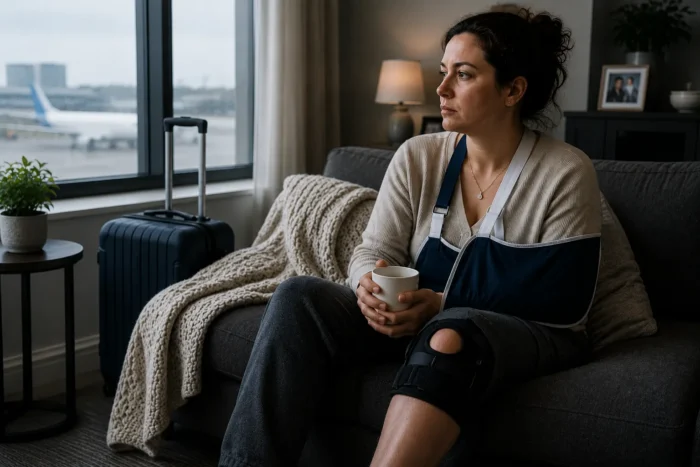
Georgia airline injury FAQs covering Montreal Convention, turbulence, luggage falls, carrier liability & deadlines. Haug Barron Law Group.
Airline Injury FAQs
Can I sue an airline for injuries sustained during a flight that departed from or arrived in Georgia?
Yes. If you were injured on an airline flight that departed from or arrived at Hartsfield-Jackson Atlanta International Airport or any other Georgia airport, you generally have the right to pursue a personal injury claim. Federal law — specifically the Montreal Convention for international flights and the Warsaw Convention for certain older international agreements — governs the liability framework, while domestic flights may involve additional state tort claims. An experienced Georgia personal injury attorney at Haug Barron Law Group can evaluate the exact legal pathway available to you.
What law governs airline injury claims — federal or Georgia state law?
For international flights, the Montreal Convention (formally, the Convention for the Unification of Certain Rules for International Carriage by Air, 1999) is the controlling treaty and caps liability at approximately 113,100 Special Drawing Rights (SDRs) for the first tier of damages without proof of fault, with unlimited recovery above that threshold if you can show the carrier’s negligence. For purely domestic flights between U.S. cities, general federal aviation regulations and state tort law principles both apply, though federal preemption issues can arise. Given these complexities, having a knowledgeable Georgia aviation injury lawyer is critical.
What types of airline injuries can give rise to a personal injury claim?
Claims arise from a wide spectrum of injuries including: traumatic brain injuries from overhead bin luggage falls; fractured bones from turbulence without adequate warning; spinal injuries from sudden hard landings; burns or scalding injuries from beverage spills; slip-and-fall injuries in aircraft aisles or jetways; assault or battery by crew or fellow passengers when the airline failed to act; deep vein thrombosis (DVT) complications from prolonged seat confinement without duty-of-care warnings; and wrongful death. If your injury was caused by the airline’s negligence or a crew member’s failure to act, you may have a viable claim.
Who can be held liable for my airline injury?
Potentially liable parties include: (1) the airline/air carrier itself for negligent operation, inadequate crew training, or failure to warn of known dangers; (2) the aircraft manufacturer if a defect caused the injury (products liability); (3) the airport authority if a condition in the terminal or jetway caused the harm; (4) maintenance companies responsible for aircraft upkeep; (5) ground handling crews; and (6) individual crew members in certain circumstances. Haug Barron Law Group conducts thorough investigations to identify every potentially responsible party and maximize your recovery.
What is the Montreal Convention and how does it affect my claim?
The Montreal Convention is an international treaty ratified by the United States that governs passenger liability on international airline flights. It establishes a two-tier strict liability system: up to approximately 113,100 SDRs (roughly $150,000 USD, subject to exchange rate fluctuation), the airline is strictly liable with no fault required; above that threshold, the airline is liable unless it can prove the injury was not due to its negligence or wrongful act. Critically, the Convention requires you to file within two years. An attorney at Haug Barron Law Group can help you navigate these treaty obligations effectively.
Does it matter that I signed a ticket contract or waiver when I purchased my airline ticket?
Airline ticket contracts of carriage do contain limitation-of-liability language, but these provisions are not absolute bars to recovery. Courts have held that agreements purporting to release airlines from the consequences of their own negligence are often unenforceable as against public policy, particularly when serious bodily injury or death results from gross negligence. Federal aviation law also preempts attempts by airlines to contract away rights established by the Montreal Convention for international flights. Our attorneys will evaluate the specific terms of your ticket agreement and advise you on your options.
What should I do immediately after being injured on an airline?
First, seek emergency medical attention. Second, report the incident in writing to the airline crew and request that a formal report be completed before deplaning. Third, document everything — photograph your injuries, the scene, and any hazardous condition. Fourth, gather names and contact information of witnesses including fellow passengers and flight attendants. Fifth, preserve all medical records, boarding passes, receipts, and correspondence. Sixth, and most importantly — do not give a recorded statement to the airline’s insurance representatives before speaking to an attorney. Contact Haug Barron Law Group at before making any statements that could affect your claim.
Can I recover if I was injured by another passenger’s carry-on bag falling from an overhead bin?
Yes, this is one of the most common airline injury scenarios. Airlines and their crew members have a duty to ensure overhead compartments are properly secured and to warn passengers of dangers. If a crew member failed to properly stow luggage, failed to warn of an improperly loaded bin, or the airline’s own boarding and stowage procedures were negligent, you have a viable claim. Traumatic head and neck injuries from falling luggage can be severe and life-altering. These cases can involve both the airline and potentially the passenger who improperly stowed the bag.
Are there special rules for catastrophic injuries like spinal cord injuries or traumatic brain injuries suffered on a plane?
Catastrophic injuries from airline accidents — including spinal cord injuries, traumatic brain injuries (TBI), severe burns, and amputations — require a specialized legal approach because the damages are extraordinary and the medical evidence complex. Life care planners, neurosurgeons, rehabilitation experts, and economic experts must be retained to quantify lifetime care costs and lost earning capacity. Haug Barron Law Group specializes in catastrophic injury and wrongful death cases and has the resources and relationships with leading medical experts to build the strongest possible case for maximum compensation.
What if my child was injured on an airline?
Parents or legal guardians may pursue personal injury claims on behalf of minor children injured on airlines. Georgia law tolls (pauses) the statute of limitations for minors until they reach the age of majority in most circumstances under O.C.G.A. § 9-3-90, but important exceptions and international treaty deadlines may still apply. Court approval of minor settlements is also required under Georgia law to protect the child’s interests. The attorneys at Haug Barron Law Group handle minor injury cases with the additional care and advocacy these vulnerable clients deserve.