
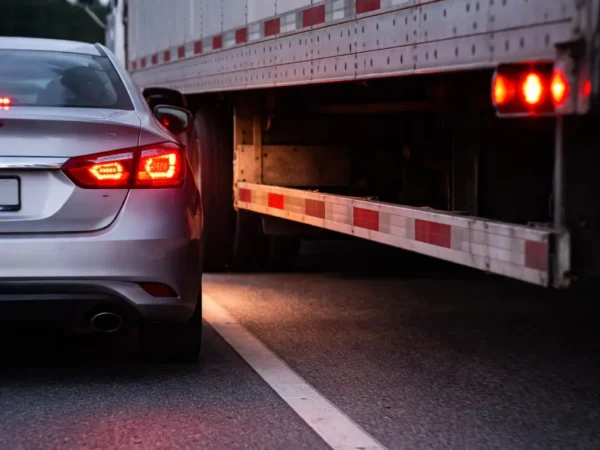
What Is an Underride Collision?
Underride collisions occur when a smaller vehicle slides beneath the body of a large commercial truck during a crash. Because semi-trucks ride significantly higher off the ground than passenger vehicles, the trailer's undercarriage can shear off a car's roof at windshield height or lower — causing devastating and often fatal injuries. These crashes rank among the most deadly type of truck accident on Georgia roads, yet they are frequently preventable.
At Haug Barron Law Group, Personal Injury Lawyers, we exclusively represent injured victims and their families — never insurance companies. If you were hurt in an underride collision anywhere in Georgia, our team is ready to fight for the full compensation you deserve.⚠️ If you or a loved one survived an underride collision with a semi-truck in Georgia, you may be entitled to significant compensation. Haug Barron Law Group represents victims across Atlanta, Sandy Springs, and Decatur. Call us today: (844) 428-4529
Types of Underride Collisions Involving Semi-Trucks
Georgia roadways see several distinct types of underride crashes, each with different causes and liable parties.
Rear Underride Collisions
The most common form. A car traveling at highway speed rear-ends a stopped or slow-moving semi-truck and slides under the trailer’s rear end. Federal regulations under 49 C.F.R. § 393.86 require rear underride guards (“Mansfield bars”) on most large trailers — but these guards are often inadequate, poorly maintained, or absent on older equipment.
Side Underride Collisions
Occur when a vehicle slides under the side of a trailer during a wide turn, lane change, or intersection crash. The Insurance Institute for Highway Safety (IIHS) has documented that the U.S. has no federal requirement mandating side underride guards — unlike Canada and several European nations. This regulatory gap has cost countless lives.
Front Override / Truck Rear-End Crashes
When a truck fails to brake in time and overrides the rear of a smaller vehicle, often due to distracted driving, brake failure, or hours-of-service violations.
Intersection Underride Crashes
When a turning truck allows a crossing vehicle to slide under the trailer’s side. Especially deadly at night when trailers lack adequate reflective markings.
Why Underride Collisions Are So Catastrophically Dangerous
The physics of underride crashes explain extreme injury rates:
- Passenger compartment safety systems — crumple zones, airbags, seat belts — are bypassed entirely when a trailer shears across the windshield line.
- Traumatic brain injury, decapitation, and severe facial trauma are common even at relatively low speeds.
- Rollover, entrapment, and post-crash fire compound the initial impact.
- Survivors frequently face permanent disability requiring decades of ongoing care.
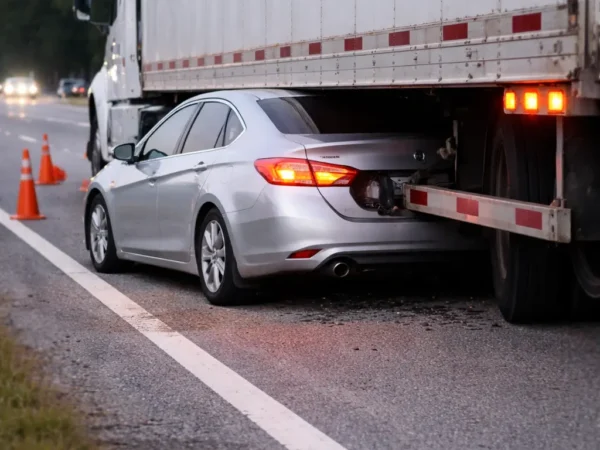
Underride crashes routinely involve multiple liable defendants — the truck driver, the trucking company, the trailer owner, the manufacturer, and maintenance providers. Our attorneys identify all responsible parties to maximize your recovery.
Federal Safety Regulations Governing Underride Guards
Trucking companies operating in Georgia are subject to FMCSA regulations covering equipment, maintenance, and safety standards.
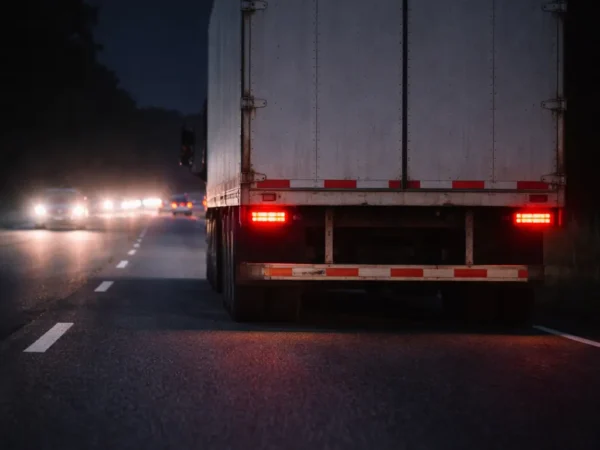
- 49 C.F.R. § 393.86 – Rear Impact Guards: Mandates rear underride protection meeting specific force thresholds. Many older trailers use guards that the IIHS has shown fail catastrophically in offset impacts.
- 49 C.F.R. § 393.11 – Lamps and Reflective Devices: Trailers must display proper reflective markings. Inadequate marking is a frequent contributing factor in nighttime underride crashes.
- 49 C.F.R. Part 396 – Inspection, Repair, and Maintenance: Carriers must maintain guards in proper working condition. Broken welds, bent guard rails, and missing hardware are maintenance violations establishing liability.
- No Federal Side Underride Requirement: The regulatory gap on side guards does not eliminate liability; a company’s failure to adopt a reasonably available safety measure supports a negligence claim.
Georgia’s motor vehicle laws under O.C.G.A. Title 40 impose additional duties on commercial vehicle operators. Violations of state or federal safety regulations constitute evidence of negligence — and sometimes negligence per se — in Georgia courts.
Who Can Be Held Liable in a Georgia Underride Crash?
Georgia’s modified comparative fault rules (O.C.G.A. § 51-12-33) allow recovery as long as you are less than 50% at fault — making complete defendant identification critical.
- The Truck Driver — Fatigue, distraction, impairment, speeding, and improper lane changes. Driver logs, cell phone records, and toxicology evidence are key.
- The Trucking Company — Liable under respondeat superior and independently for negligent hiring, training, supervision, and equipment maintenance.
- The Trailer Owner or Leasing Company — May owe independent duties regarding equipment safety when the trailer is separately owned.
- The Trailer Manufacturer — Product liability claims under O.C.G.A. § 51-1-11 for defectively designed or manufactured underride guards.
- Third-Party Maintenance Providers — Companies contracted to inspect and maintain guards may bear liability for negligent work.
- Cargo Owners or Shippers — Overloading, improper cargo securing, or unrealistic delivery schedules may give rise to shipper liability.
- Government Entities — Road design or signage failures may support a claim against a Georgia municipality or GDOT, subject to ante litem notice under O.C.G.A. § 36-11-1.
Commercial trucking companies carry large insurance policies, but those limits can be exhausted quickly in catastrophic underride cases. Identifying and pursuing multiple defendants — including the trailer manufacturer on a product liability theory — can dramatically increase the total recovery available to you.
Critical Evidence in Georgia Underride Collision Cases
Trucking companies sometimes engage in spoliation — destroying records before litigation. At Haug Barron Law Group, we send spoliation letters the moment we are retained and move quickly to preserve:
- Electronic Logging Device (ELD) data and Hours of Service records
- ECM / “black box” data (speed, braking, throttle at time of crash)
- Dashcam and surveillance footage from the crash scene
- Post-crash inspection and metallurgical analysis of the underride guard
- Driver’s qualification file, training records, and disciplinary history
- Mandatory post-crash drug and alcohol testing results (49 C.F.R. § 382.303)
- Carrier’s maintenance records for the specific trailer
- FMCSA CSA scores and roadside inspection history
- Accident reconstruction and biomechanical expert analysis
Georgia courts recognize the doctrine of spoliation of evidence, which can result in adverse jury instructions if records are destroyed after proper notice. For more detail, see our related page on trucking company spoliation of evidence in Georgia.
Injuries Commonly Caused by Underride Collisions
Given the catastrophic physics involved, survivors of underride crashes frequently face severe, life-altering injuries:
- Traumatic Brain Injury (TBI) — Open/closed head injuries, contusions, diffuse axonal injury
- Spinal Cord Injury — Paraplegia, quadriplegia, disc herniation, vertebral fractures
- Severe Facial Trauma — Lacerations, orbital fractures, jaw injuries, permanent disfigurement
- Skull Fractures — Often with intracranial hemorrhage
- Loss of Limb — Traumatic amputation or degloving injuries
- Burn Injuries — Severe burns when post-crash fire occurs
- Psychological Trauma — PTSD, depression, anxiety, survivor’s guilt
- Internal Organ Damage — Crush injuries, lacerated liver or spleen, pneumothorax
- Multiple Fractures — Pelvis, ribs, and long bones
- Wrongful Death — Tragically, many underride collisions are fatal
Compensation Available in Georgia Underride Collision Cases
Economic Damages
- Past and future medical expenses: surgeries, hospitalization, rehabilitation, in-home care
- Lost wages and future loss of earning capacity
- Disability accommodations and assistive devices
- Property damage and vehicle replacement
- Funeral and burial expenses in wrongful death cases
Non-Economic Damages
- Pain and suffering
- Mental anguish and emotional distress
- Loss of enjoyment of life
- Disfigurement and permanent disability
- Loss of consortium
Punitive Damages
Under O.C.G.A. § 51-12-5.1, Georgia courts may award punitive damages when the defendant’s conduct demonstrates willful misconduct, malice, or conscious indifference. Evidence that a carrier knowingly operated a trailer with a defective or non-compliant guard is strong support for a punitive damages claim.
Wrongful Death Claims: When an Underride Collision Is Fatal
Georgia’s Wrongful Death Act (O.C.G.A. § 51-4-1 et seq.) allows surviving family members to seek compensation for the full value of the deceased’s life, plus the estate’s claims for final medical expenses and funeral costs. Our attorneys handle these cases with compassion and determination — so grieving families can focus on healing while we pursue justice.
⏰ Statute of Limitations Warning: Georgia’s statute of limitations for personal injury and wrongful death claims is generally two years from the date of injury (O.C.G.A. § 9-3-33). Claims against government entities may require ante litem notice within six months. Do not wait — call Haug Barron Law Group immediately.
Why Choose Haug Barron Law Group?
Haug Barron Law Group is a plaintiff-only personal injury firm headquartered in Atlanta with offices in Sandy Springs and Decatur. We never represent insurance companies. When you call us, you work directly with attorneys committed exclusively to your recovery.
- Plaintiff-Only Practice — We exclusively represent injured victims, never corporations or insurers.
- Disputed Liability Experience — Of-counsel attorney Mark Jackson specializes in complex disputed liability cases.
- Federal Court Ready — We handle cases in the Northern District of Georgia (NDGA) when defendants remove to federal court.
- Immediate Spoliation Protection — We preserve critical evidence from day one.
- No Fee Unless We Win — All truck accident cases handled on contingency.
- Atlanta Metro Offices — Serving Atlanta, Sandy Springs, Decatur, and all of Georgia.
The National Push for Stronger Underride Guard Standards
The Insurance Institute for Highway Safety has tested current rear underride guards and found many fail in offset impacts. Organizations including the Truck Safety Coalition have advocated for legislation requiring stronger side and rear guards. The NHTSA has published research on underride protection, and Congress has considered multiple bills to mandate upgraded standards.
In litigation, evidence that an industry-wide push for better safety standards existed — and a defendant chose not to adopt those measures — powerfully supports both negligence and punitive damages claims.
Have questions about underride truck accidents?
Visit our Georgia Truck Accident FAQs to learn why these crashes are so dangerous, how liability is determined, and what evidence matters in these cases.
Related Resources & Practice Areas
- Georgia Truck Accident Lawyers
- Hours of Service Violations & Fatigued Truck Driver Accidents
- Truck Black Box Evidence in Georgia Crashes
- Overloaded Cargo & Unsecured Load Truck Accidents
- Freight Broker Liability in Georgia Truck Accidents
- Trucking Company Spoliation of Evidence in Georgia
- FMCSA Compliance, Safety, Accountability (CSA) Data
- National Highway Traffic Safety Administration – Underride Protection
- Insurance Institute for Highway Safety – Large Trucks
Underride collisions with semi-trucks are among the most devastating and often fatal crash types on Georgia roads. Contact Haug Barron Law Group to discuss your case and pursue full accountability.
This page is intended for general informational purposes only and does not constitute legal advice. No attorney-client relationship is formed by reading this content. Results in prior cases do not guarantee similar outcomes in future matters.
Start Your Case Today
Contact Haug Barron Law Group Today for a FREE Consultation.