
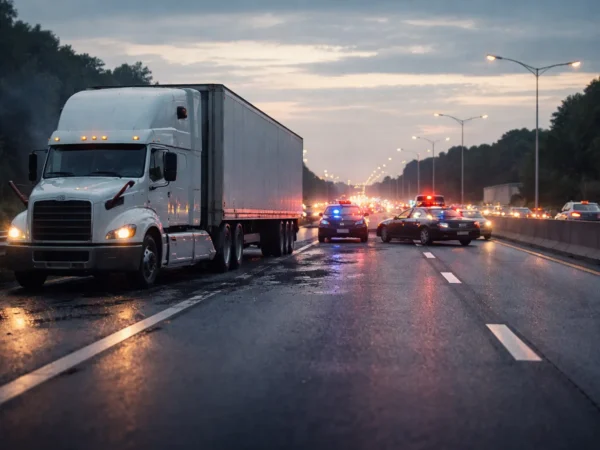
The Case That Could Change Everything for Truck Accident Victims
The U.S. Supreme Court is deciding whether freight brokers can be held responsible when the carriers they hire cause catastrophic crashes. For Georgia truck accident victims, the stakes could not be higher.
When a tractor-trailer destroys a family’s life, who bears legal responsibility? The obvious answer is the driver and the trucking company. But modern freight logistics is far more complicated. Between the shipper who needs goods moved and the truck that ultimately hauls them, there is often an invisible middleman — the freight broker — who selects the carrier, negotiates the rate, and dispatches the load. And until the U.S. Supreme Court issues its decision in Montgomery v. Caribe Transport II, LLC, whether that broker can be held accountable under state law is one of the most fiercely contested questions in American trucking law.

At Haug Barron Law Group, Personal Injury Lawyers, we represent Georgians who have been seriously hurt by commercial vehicles — on I-285, I-75, I-20, and the interstates, state routes, and local roads across our state. We are watching Montgomery v. Caribe Transport closely because its outcome will directly shape how we pursue justice for our clients who are injured by negligently-selected carriers.
This article explains the case, the law, what it means for Georgia specifically, and what you should do if you or a loved one has been hurt in a truck accident involving a freight broker.
What Happened: The Crash That Started It All
The underlying tragedy is straightforward. On a December night in 2017, Shawn Montgomery was stopped on the shoulder of an Illinois highway inspecting his tractor-trailer when a 1995 Freightliner driven by Yosniel Varela-Mojena came off the road at high speed and rear-ended his truck. Montgomery suffered devastating injuries, including the amputation of his leg and permanent disfigurement.
Varela-Mojena was employed by Caribe Transport II, LLC, an Indiana-based interstate motor carrier. The shipment had been arranged by one of the largest freight brokers in the world: C.H. Robinson Worldwide, Inc. C.H. Robinson, operating under a broker-carrier agreement, had selected Caribe Transport to perform the delivery.
Montgomery sued not just the driver and the carrier, but also C.H. Robinson, alleging that the broker had negligently hired Caribe Transport — that Robinson knew or should have known the carrier was unsafe, yet dispatched them anyway. This claim, known as negligent selection, is the central legal battleground in the case.
Montgomery v. Caribe Transport at a Glance: Crash date: December 2017, Williamson County, Illinois. Victim: Shawn Montgomery — leg amputated, permanently disfigured. At-fault driver: Yosniel Varela-Mojena, employed by Caribe Transport II, LLC. Freight broker: C.H. Robinson Worldwide, Inc. Central issue: Can a truck accident victim sue the freight broker under state negligence law? Argued before the U.S. Supreme Court on March 4, 2026; decision expected by June 2026. Case Number: No. 24-1238.
What Is Freight Broker Liability — And Why Does It Matter?
A freight broker is a middleman. Brokers do not own trucks, employ drivers, or transport goods themselves. Their business is connecting shippers who need cargo moved with motor carriers who have the capacity to move it. According to industry data, freight brokers have grown from under 6% of U.S. truckload freight in 2000 to approximately 27% today.
This growth is significant. Because brokers select carriers, they have the ability — and arguably the duty — to screen those carriers for safety. If a broker knowingly selects a carrier with a terrible safety record, repeated hours-of-service violations, or a pattern of unsafe driving, and that carrier’s driver then causes a catastrophic crash, should the broker be held legally accountable?
Common sense says yes. The tort doctrine of negligent selection — sometimes called negligent hiring — provides exactly this remedy under state law. A party who negligently hires an incompetent or dangerous contractor can be held liable for the harm that contractor causes. The trucking industry says federal law says otherwise.
The Legal Fight: Federal Preemption Under the FAAAA
The core defense freight brokers deploy is federal preemption under the Federal Aviation Administration Authorization Act of 1994 (the “FAAAA”), 49 U.S.C. § 14501(c). This statute contains a sweeping preemption clause prohibiting states from enacting or enforcing any law “related to a price, route, or service of any motor carrier . . . or any motor private carrier, broker, or freight forwarder with respect to the transportation of property.”
Brokers argue that a state negligence lawsuit requiring them to screen carriers more carefully is a law “related to” their services — and is therefore wiped out by federal law. Victims respond that this was never Congress’s intent. Congress created the FAAAA to eliminate economic regulations like tariffs and price controls, not to immunize brokers from basic safety accountability.
Key Statute — FAAAA Safety Exception: 49 U.S.C. § 14501(c)(2)(A) — The FAAAA’s preemption clause “shall not restrict the safety regulatory authority of a State with respect to motor vehicles.” The entire Montgomery case turns on whether this safety exception rescues state negligent-selection claims from preemption.
The Circuit Split That Created Legal Chaos
For years before Montgomery, federal appeals courts reached opposite conclusions — creating a national patchwork that left accident victims’ rights entirely dependent on which state the crash happened in:
| Circuit | Key Case | Outcome for Victims |
|---|---|---|
| 9th Circuit | Miller v. C.H. Robinson Worldwide, Inc. (2020) | Pro-Victim — Safety exception applies; claims survive preemption |
| 6th Circuit | Cox v. Total Quality Logistics, Inc. (2025) | Pro-Victim — Safety exception applies; claims survive preemption |
| 7th Circuit | Ye v. GlobalTranz Enterprises, Inc. (2023) | Pro-Broker — FAAAA preempts claims; no safety exception |
| 11th Circuit (covers Georgia) | Aspen Am. Ins. Co. v. Landstar Ranger, Inc. (2023) | Pro-Broker — FAAAA preempts claims; no safety exception |
This meant that a Georgia victim injured by a negligently-selected carrier faced a fundamentally different legal landscape than a victim in California or Ohio. The same crash, the same broker misconduct, the same catastrophic injuries — but entirely different outcomes depending on geography. The Supreme Court accepted Montgomery specifically to resolve this nationwide split.
What Georgia Law Has Said — And Why It Matters Now
Georgia sits within the Eleventh Circuit, which has sided with brokers. In Aspen American Insurance Co. v. Landstar Ranger, Inc. (11th Cir. 2023), the Eleventh Circuit held that negligent-selection claims against freight brokers are preempted by the FAAAA and that the safety exception does not apply. Georgia federal courts have followed suit.
Most recently, in Pinder v. Lancer Insurance Co. (M.D. Ga. Sept. 27, 2024), the Middle District of Georgia held that negligent hiring, retention, entrustment, supervision, training, and joint venture claims against freight brokers were preempted by the FAAAA and not saved by the safety exception — relying directly on the Eleventh Circuit’s Aspen decision.
This means that right now, under current Georgia law, if you are injured by a carrier that a broker negligently selected, your direct negligent-selection claim against the broker is very likely to be dismissed in federal court.
“No matter how dangerous the carrier or driver is — and no matter if the broker had every reason to know about that danger — under the current Eleventh Circuit rule, Georgia victims cannot hold that broker accountable in state negligence court.”
— Montgomery’s Brief to the U.S. Supreme Court (paraphrased)
Montgomery v. Caribe Transport could change all of this. A ruling in favor of Shawn Montgomery would mean that Georgia victims can once again pursue freight brokers for negligent selection — giving injured families access to an entire additional layer of accountability and insurance coverage.
The Supreme Court Argument: What Happened on March 4, 2026
Oral arguments were heard on March 4, 2026. The justices grappled with the central question: what does “with respect to motor vehicles” mean in the FAAAA’s safety exception? Does it require a direct link to the physical operation of a truck — or does it extend to state tort laws designed to prevent dangerous trucks from reaching the road in the first place?
The case drew massive attention. The U.S. Chamber of Commerce filed an amicus brief on behalf of the broker. Amazon, major trade associations, and even the federal Solicitor General weighed in. The scope of participation underscores just how consequential this ruling will be — not just for accident victims, but for the entire freight logistics industry.
The Supreme Court’s decision is expected by the end of June 2026. Whatever the Court rules will be binding on every court in the country and will conclusively resolve the circuit split.
Even If the Court Rules Against Victims: Other Claims Remain Available
At Haug Barron Law Group, we want Georgia truck accident victims to understand this clearly: even if the Supreme Court affirms preemption, freight broker liability is not eliminated entirely. Several powerful legal theories remain available regardless of how Montgomery is decided.
Vicarious Liability / Agency
If the evidence shows that a broker exercised sufficient control over the carrier — setting hours, directing operations, monitoring routes — the broker may be held liable as an employer or principal, not merely as a broker. In Montgomery itself, the courts examined whether C.H. Robinson’s use of tracking software and check-in calls established the level of control needed to create an agency relationship. Factual control remains a live issue independent of the FAAAA.
Direct Negligence Claims Against the Carrier
The FAAAA does not shield the motor carrier or its driver. Claims for negligent hiring, entrustment, supervision, and training remain fully viable against the carrier itself. These claims, combined with negligent operation claims against the driver, form the foundation of most truck accident cases.
FMCSA Safety Regulations as a Standard of Care
Carriers are governed by extensive Federal Motor Carrier Safety Regulations (FMCSRs) administered by the Federal Motor Carrier Safety Administration. Violations of these regulations — improper hours of service, lack of driver qualification file documentation, inadequate vehicle maintenance — are powerful evidence of negligence against the carrier.
Direct Negligence Against the Shipper
In some cases, the company that hired the broker — the shipper — may also bear liability if it knew or should have known about safety problems with the carriers being used. As freight litigation has grown more sophisticated, shippers are increasingly named as defendants.
Relevant Georgia Statutes in Truck Accident Cases:
O.C.G.A. § 51-12-33 — Georgia’s modified comparative negligence statute. If you are less than 50% at fault, you can recover damages — but your recovery is reduced proportionally by your share of fault. If you are 50% or more at fault, you recover nothing.
O.C.G.A. § 9-3-33 — Two-year statute of limitations for personal injury claims. You generally must file suit within two years of the crash, or your claim is barred forever.
O.C.G.A. § 51-1-11 — Georgia’s products liability statute, which may apply if defective truck equipment contributed to the crash.
What Should You Do If You Were Hit by a Carrier a Broker Selected?
Time is your enemy in commercial vehicle litigation. Trucking companies and their insurers mobilize rapid-response teams within hours of a serious crash to preserve evidence favorable to the defense — and destroy or allow to lapse evidence favorable to you. Here is what you must do:
- Seek immediate medical care. Your health comes first. Document every injury, every treatment, every diagnosis.
- Call an attorney immediately — before speaking with any insurance company. Adjusters are trained to gather statements that reduce or eliminate your claim.
- Preserve everything. Do not allow the trucking company to inspect or repair the truck without your attorney’s involvement. Demand preservation of the black box (ECM), dashcam footage, driver logs, hours-of-service records, and carrier selection records.
- Identify the broker. In many crashes, the existence of a freight broker is not obvious from the accident scene. Your attorney must investigate the shipper-broker-carrier chain to identify all potentially liable parties.
- Act before the statute of limitations runs. Georgia’s two-year statute of limitations (O.C.G.A. § 9-3-33) is strict. Missing it forfeits your right to compensation forever.
Why Haug Barron Law Group for Your Truck Accident Claim
Haug Barron Law Group, Personal Injury Lawyers is a plaintiff’s personal injury firm based in Atlanta, Georgia, with offices in Sandy Springs and Decatur. We exist for one purpose: fighting for individuals and families who have been seriously hurt by the negligence of others. We do not represent trucking companies, freight brokers, or insurers. We never will.
Our attorneys understand that commercial vehicle litigation is not a typical personal injury case. It demands expertise in federal motor carrier regulations, familiarity with the logistics industry’s documentation practices, and the ability to identify every potentially responsible party — including brokers, shippers, leasing companies, and maintenance contractors.
Have questions about broker liability in truck accident cases?
Visit our Georgia Truck Accident FAQs to learn how recent legal developments affect liability, what evidence matters, and who may be responsible after a crash.
Conclusion: A Landmark Ruling — And Why Georgia Victims Cannot Wait
Montgomery v. Caribe Transport II, LLC is not a distant legal abstraction. It is a case about whether corporations that profit from putting trucks on the road can be shielded from accountability when those trucks — chosen carelessly — destroy lives. The Supreme Court’s answer, expected by June 2026, will reshape freight broker liability nationwide and directly affect the rights of Georgians injured in commercial vehicle crashes.
Whatever the Court decides, one thing is certain: pursuing maximum compensation in a truck accident case involving a freight broker requires attorneys who understand the full legal landscape — federal preemption, agency doctrine, FMCSA regulations, and the Georgia-specific rules that govern your recovery.
If you or someone you love has been seriously injured in a truck or commercial vehicle crash in Georgia, do not wait. Contact Haug Barron Law Group, Personal Injury Lawyers for a free, confidential case evaluation. We serve clients from our offices in Atlanta, Sandy Springs, and Decatur, and throughout the State of Georgia.
Broker liability in Georgia truck accident cases can significantly expand the parties responsible for your injuries. Contact Haug Barron Law Group to discuss your case and pursue full compensation.
Disclaimer: This article is for informational purposes only and does not constitute legal advice. Reading this article does not create an attorney-client relationship with Haug Barron Law Group. Laws and case status are subject to change. Consult a qualified attorney for advice regarding your specific legal situation. Montgomery v. Caribe Transport II, LLC is pending as of the date of this article’s publication; outcomes may differ based on the Court’s eventual ruling. © 2026 Haug Barron Law Group. All rights reserved. Privacy Policy.
Start Your Case Today
Contact Haug Barron Law Group Today for a FREE Consultation.