
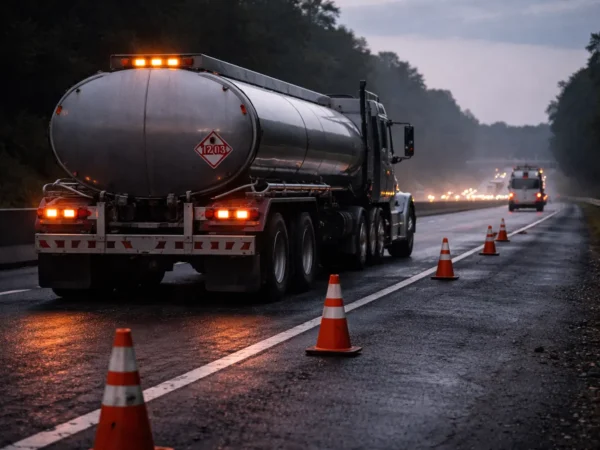
Georgia's Most Dangerous Roads Carry More Than Freight
When a tanker carrying flammable fuel, toxic chemicals, or corrosive materials crashes on a Georgia highway, the consequences are catastrophic — and the legal fight is complex. Haug Barron Law Group levels the playing field against trucking companies and their insurers.
Georgia sits at the crossroads of the Southeast, with Interstate 75, I-85, I-285, and I-20 serving as critical corridors for commercial freight — including tanker trucks transporting gasoline, propane, industrial chemicals, chlorine, anhydrous ammonia, and dozens of other hazardous materials. Every day, thousands of these vehicles travel through Atlanta, Sandy Springs, Decatur, and surrounding communities.
When a tanker truck accident occurs, the dangers extend far beyond typical collisions. A ruptured tank can trigger fires, explosions, toxic spills, and widespread chemical exposure affecting not only crash victims but surrounding neighborhoods. The injuries — burns, respiratory damage, chemical poisoning, neurological harm — are often life-altering or fatal.
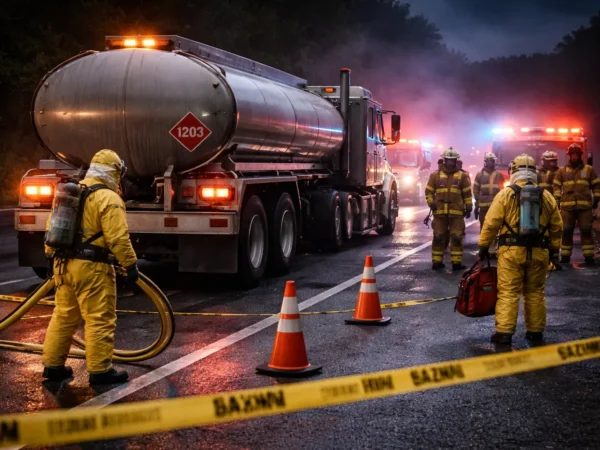
If you or a loved one was injured in a Georgia tanker truck accident involving hazardous materials, you need an attorney who understands both the science of HAZMAT incidents and the complex web of federal and state regulations that govern them. Haug Barron Law Group — serving clients from our offices in Atlanta, Sandy Springs, and Decatur — has that experience. Call us at (844) 428-4529 for a free, no-obligation consultation.
The Federal Motor Carrier Safety Administration (FMCSA) and the Pipeline and Hazardous Materials Safety Administration (PHMSA) impose strict regulatory requirements on carriers transporting hazardous materials. Violations of these rules — which our attorneys investigate thoroughly — often form the backbone of successful HAZMAT injury claims.
Why Tanker Truck Hazmat Cases Are Uniquely Complex
Multiple Layers of Federal Regulation
Tanker trucks carrying hazardous materials must comply with a dense framework of federal regulations, including 49 C.F.R. Parts 390–399 (FMCSA Safety Regulations), 49 C.F.R. Parts 100–185 (Hazardous Materials Regulations), and applicable provisions of the Occupational Safety and Health Administration (OSHA). Violations of these regulations — improper placarding, inadequate driver training, defective tank construction — can establish negligence per se in a Georgia civil action.
More Defendants, More Insurance Coverage
Unlike a standard vehicle collision, a HAZMAT tanker accident often involves multiple liable parties: the truck driver, the trucking company, the cargo shipper, the tank manufacturer or inspector, a freight broker, and potentially a government entity responsible for road conditions. This means more insurance policies available to compensate you — and more parties whose attorneys will be working against you from day one.
Evidence Preservation Is Time-Critical
Tanker trucks are equipped with electronic logging devices (ELDs), forward-facing cameras, GPS tracking systems, and engine control module (ECM) black boxes. Trucking companies and their insurers deploy rapid-response teams immediately after major accidents to begin damage control. Without an experienced Georgia HAZMAT truck accident attorney issuing a litigation hold and preserving evidence, critical data disappears.
⚠ Evidence Destruction Warning: Under 49 C.F.R. § 395.8, carriers are only required to retain certain records for limited periods. If you delay contacting an attorney, crucial evidence — including the truck’s black box data, hours-of-service logs, maintenance records, and cargo manifests — may be legally destroyed.
Specialized Expert Witnesses
Successfully litigating a HAZMAT tanker case requires input from toxicologists, accident reconstruction specialists, chemical engineers, HAZMAT compliance experts, and medical specialists in burn and chemical exposure injuries. Haug Barron Law Group works with a network of qualified experts who can speak directly to the cause of your injuries and their long-term consequences.
Common Hazardous Materials Transported by Tanker Trucks in Georgia
Under 49 C.F.R. § 172.101 (Hazardous Materials Table), the federal government classifies dangerous goods into nine categories. Georgia’s highways regularly carry materials from every class. Each presents distinct dangers to accident victims.
| DOT Class | Substance Type | Hazards to Victims |
|---|---|---|
| Class 1 | Explosives (blasting agents, fireworks, ammunition) | Catastrophic blast radius; traumatic brain injury and severe burns |
| Class 2 | Flammable Gases (propane, butane, natural gas) | High ignition risk; explosions and fire exposure cause third-degree burns and smoke inhalation injuries |
| Class 3 | Flammable Liquids (gasoline, diesel, ethanol) | Among the most common tanker cargo in Georgia; fires can engulf nearby vehicles and structures |
| Class 4 | Flammable Solids (lithium batteries, metallic sodium) | Spontaneous combustion risk even without collision-related ignition sources |
| Class 5 | Oxidizers & Peroxides (chlorine, hydrogen peroxide, ammonium nitrate) | Can intensify fires and cause severe chemical burns on contact |
| Class 6 | Toxic Substances (pesticides, cyanide, arsenic) | Neurological damage, organ failure, and long-term chronic illness |
| Class 7 | Radioactive Materials (medical isotopes, uranium compounds) | Radiation exposure injuries may not manifest for months or years post-accident |
| Class 8 | Corrosives (sulfuric acid, hydrochloric acid, sodium hydroxide) | Severe chemical burns on contact; inhalation causes permanent lung damage |
| Class 9 | Miscellaneous Hazards (dry ice, magnetized materials, lithium batteries) | Diverse hazard profiles requiring specialized medical evaluation of exposures |
Our attorneys understand the specific hazards of each substance class and partner with toxicology experts to document the full scope of chemical exposure injuries — including latent conditions that may not be diagnosed for years after the accident.
Who Is Responsible for a Georgia Tanker Truck HAZMAT Accident?
Georgia follows a modified comparative fault system under O.C.G.A. § 51-12-33. As long as you are less than 50% at fault, you may recover damages. Identifying all liable parties is critical to maximizing your recovery.
- The Truck Driver — Fatigue, impairment, distracted driving, failure to follow HAZMAT handling protocols, and lack of proper CDL Hazmat Endorsement training all constitute driver negligence.
- The Trucking Company (Motor Carrier) — Carriers are vicariously liable for driver negligence under respondeat superior. They may also be directly liable for negligent hiring, inadequate training, failure to maintain vehicles, and hours-of-service violations under 49 C.F.R. Part 395.
- The Cargo Shipper or Owner — Shippers who improperly classify, package, label, or document hazardous materials may bear liability under 49 C.F.R. Part 173.
- The Tank Manufacturer or Inspector — Defective tank design, welding failures, or inadequate inspection under 49 C.F.R. Part 178 standards may support a products liability claim under Georgia law.
- Freight Brokers — Under emerging case law, freight brokers who negligently select unsafe carriers may be liable. Our firm has particular experience with freight broker liability following Georgia federal court decisions in this area.
- Government Entities — If road design defects, missing signage, or negligent maintenance contributed to the crash, a government entity may bear liability under Georgia’s sovereign immunity waiver provisions at O.C.G.A. § 50-21-24.
Key Federal & Georgia Regulations Governing Hazmat Tanker Trucks
Violations of the following regulations frequently give rise to negligence claims in Georgia HAZMAT tanker truck cases. Our attorneys review compliance records against each of these standards as part of every case investigation.
| Regulation / Statute | What It Governs | Why It Matters to Your Claim |
|---|---|---|
| 49 C.F.R. Part 392 | Driving of commercial motor vehicles | Driver conduct rules; violations create negligence per se |
| 49 C.F.R. Part 395 | Hours-of-service regulations | Fatigued driving; log falsification evidence |
| 49 C.F.R. Part 396 | Inspection, repair and maintenance | Brake, tire, and tank equipment failure |
| 49 C.F.R. Part 172 | Hazmat communication (placarding, labeling) | Improper placarding delays emergency response |
| 49 C.F.R. Part 173 | Shippers’ general requirements | Improper packaging/classification by shipper |
| 49 C.F.R. Part 178 | Tank specifications and testing | Defective or uncertified tank construction |
| 49 C.F.R. Part 383 | CDL standards including HAZMAT endorsement | Unlicensed or unqualified HAZMAT driver |
| O.C.G.A. Title 40 | Georgia Motor Vehicle & Traffic Code | Georgia-specific trucking and highway violations |
| Ga. DNR Environmental Rules | Georgia hazardous waste management | State environmental liability for spill damages |
Damages Available to Georgia Tanker Truck HAZMAT Accident Victims
Georgia law allows HAZMAT accident victims to pursue both economic and non-economic damages. In cases involving egregious misconduct — such as knowingly operating a defective tanker or deliberately falsifying HAZMAT compliance records — punitive damages may also be available under O.C.G.A. § 51-12-5.1.
Economic Damages
- Emergency medical treatment, hospitalization, and surgery
- Burn center care, skin grafting, and reconstructive procedures
- Respiratory therapy and long-term pulmonary care
- Toxicology workups and ongoing chemical exposure monitoring
- Lost wages and diminished future earning capacity
- Home modification and long-term care costs
- Property damage and decontamination expenses
- Wrongful death damages under O.C.G.A. § 51-4-2
Non-Economic Damages
- Physical pain and suffering — current and future
- Emotional distress and post-traumatic stress disorder (PTSD)
- Permanent disfigurement from burns or chemical injuries
- Loss of enjoyment of life and disability
- Loss of consortium for spouses and family members
Georgia’s statute of limitations for personal injury claims is two years from the date of the accident under O.C.G.A. § 9-3-33. For wrongful death claims, the same two-year period applies. Claims against government entities may have significantly shorter notice requirements. Do not wait to contact an attorney.
What To Do After a Georgia Tanker Truck HAZMAT Accident
- Prioritize Your Safety and Medical Care. Move away from the spill or fire if you can do so safely. Call 911 immediately. Even if you feel fine, many chemical exposure injuries are not immediately apparent. Seek emergency evaluation and tell doctors about any substance you may have been exposed to.
- Do Not Speak to Insurance Adjusters. The trucking company’s insurer will contact you quickly. Do not give a recorded statement, sign anything, or accept any settlement offer without first speaking to an attorney.
- Document Everything You Can Safely Document. Photographs, witness names and phone numbers, the truck’s license plate, DOT number, and any visible placards help establish your case. However, never enter a HAZMAT zone to gather evidence.
- Obtain the Official Accident Report. Request the Georgia State Patrol or local law enforcement accident report. The Georgia Department of Public Safety investigates major commercial vehicle accidents on state highways.
- Track All Medical Treatment and Expenses. Maintain records of every medical appointment, prescription, and out-of-pocket expense related to your injuries.
- Contact Haug Barron Law Group Immediately. Call (844) 428-4529 to speak with a Georgia HAZMAT truck accident attorney. We will issue evidence preservation letters immediately and begin building your case at no upfront cost to you.
High-Risk HAZMAT Corridors in Metro Atlanta & Georgia
Georgia’s geography and industrial profile create specific concentrations of tanker truck traffic. Our attorneys have handled cases arising from accidents on virtually every major corridor in the state, including:
- I-75 (Atlanta to Valdosta): Major fuel and chemical tanker corridor connecting metro Atlanta to the Gulf Coast; heavy industrial traffic through Marietta, Macon, and Warner Robins.
- I-85 (Atlanta to South Carolina): High-volume textile and chemical corridor; frequent hazmat movement between Atlanta and Greenville-Spartanburg.
- I-285 (The Perimeter): Atlanta’s beltway sees some of the highest tanker truck concentrations in the Southeast due to airport and industrial zone proximity.
- I-20 (Augusta Corridor): Fuel, agricultural chemicals, and industrial freight connect Atlanta to Augusta’s manufacturing base.
- GA-400 / SR 400: A key corridor through Sandy Springs and Forsyth County with significant tanker traffic serving industrial parks.
- SR 166 / Camp Creek Parkway: High-risk area near Hartsfield-Jackson Atlanta International Airport with substantial fuel delivery traffic.
- Port of Savannah Connectors: As the nation’s busiest container port, Savannah generates massive outbound HAZMAT truck traffic via I-16, US-80, and GA-21.
The Georgia Department of Transportation (GDOT) and the Georgia Emergency Management and Homeland Security Agency (GEMA/HS) both play roles in HAZMAT incident response that become relevant to evidence gathering and regulatory investigation in litigation.
Have questions about hazardous tanker truck accidents?
Visit our Georgia Truck Accident FAQs to learn how liability is determined, what risks are involved, and what evidence matters in these complex cases.
Why Georgia HAZMAT Accident Victims Choose Haug Barron Law Group
Haug Barron Law Group is a plaintiff-only personal injury firm headquartered in Atlanta, Georgia. We never represent trucking companies, insurers, or corporate defendants — only the people injured by them. This singular focus shapes how we approach every case.
- Plaintiff-Only Practice. We have no conflicts of interest with the trucking industry. Our entire practice is built around maximizing recovery for injury victims.
- Federal Court Experience. Many significant trucking cases — particularly those involving federal HAZMAT regulations — are litigated in federal court. Our attorneys are fluent in Northern District of Georgia (NDGA) federal practice.
- Disputed Liability Cases. Our of-counsel attorney Mark Jackson specializes in cases where fault is contested. If a carrier or insurer argues that you were at fault, we have the resources and experience to prove otherwise.
- Rapid Evidence Preservation. We act immediately upon retention to issue litigation holds and preserve black box data, ELD records, maintenance logs, and cargo manifests before they disappear.
- HAZMAT Regulatory Knowledge. We understand 49 C.F.R. inside and out — and we know how to use regulatory violations to establish negligence and support punitive damage claims.
- Three Metro Atlanta Locations. Offices in Atlanta, Sandy Springs, and Decatur mean we are accessible and local to the communities most affected by I-285, I-75, and GA-400 corridor accidents.
- No Fee Unless We Win. You pay nothing unless we successfully recover compensation for you.
Tanker truck accidents involving hazardous materials can lead to catastrophic injuries and complex regulatory liability. Contact Haug Barron Law Group to discuss your case and pursue full compensation.
Related Practice Areas:
Black Box Evidence in Georgia Truck Accident Cases · Hours of Service Violations & Fatigued Truck Driving · Freight Broker Liability in Georgia Trucking Crashes · Overloaded & Improperly Secured Cargo Accidents · Trucking Company Spoliation of Evidence in Georgia · View All Practice Areas
Key Regulatory Resources:
FMCSA Hazardous Materials Regulations · PHMSA — Pipeline and Hazardous Materials Safety Administration · Georgia DOT · Georgia Emergency Management Agency · Georgia State Patrol · Georgia DNR Environmental Protection Division
Attorney Advertising Disclaimer: The information on this page is for general informational purposes only and does not constitute legal advice. No attorney-client relationship is formed by reading this page. Results in prior cases do not guarantee similar outcomes. © 2025 Haug Barron Law Group. All Rights Reserved. Atlanta, Sandy Springs & Decatur, Georgia. Privacy Policy.
Start Your Case Today
Contact Haug Barron Law Group Today for a FREE Consultation.