
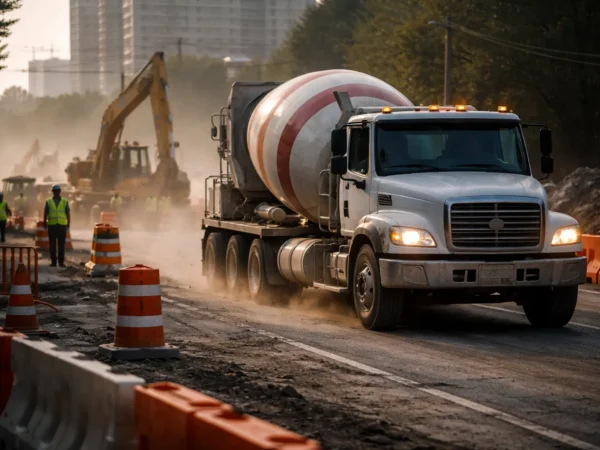
Atlanta's Construction Boom — and the Hidden Danger on Its Roads
Georgia's booming construction industry creates deadly hazards on Atlanta's roads every day. When a concrete mixer or dump truck driver's negligence shatters your life, Haug Barron Law Group is ready to fight for every dollar you deserve.
Metro Atlanta is one of the fastest-growing regions in the Southeast, with billions of dollars in highway, transit, and commercial construction underway on corridors like I-285, I-75/I-85 (the Downtown Connector), SR 400, and the Beltline. Wherever large-scale construction happens, concrete mixer trucks and dump trucks follow — massive commercial vehicles weighing up to 80,000 pounds (or more when overloaded) navigating tight construction zones and congested surface streets alongside everyday drivers.
The results can be catastrophic. Accidents involving concrete mixers and dump trucks cause some of the most severe injuries seen in personal injury law: traumatic brain injury, spinal cord damage, crush injuries, loss of limbs, and fatalities. Unlike a collision between two passenger cars, these crashes involve a profound imbalance of force — and a complex web of insurance policies, corporate defendants, and federal regulations that make recovery without experienced legal representation exceptionally difficult.

At Haug Barron Law Group, Personal Injury Lawyers, we represent injured Georgians — and only injured Georgians. We never represent trucking companies, insurers, or corporations. Our plaintiff-only focus means our interests are always perfectly aligned with yours.
Why Concrete Mixer Accidents Are Uniquely Dangerous
Concrete mixer trucks — also called transit mixers or ready-mix trucks — are among the most deceptive vehicles on the road. Their rotating drum keeps concrete in motion, which means the truck’s center of gravity shifts constantly as it moves. This dynamic load makes rollovers a persistent risk, particularly on curved exit ramps, banked highway sections, and during sudden lane-change maneuvers. Atlanta construction zones frequently route these trucks through exactly these kinds of challenging configurations.
Rollover & Tip-Over Crashes
The spinning drum creates a shifting center of gravity. Speeding on curved on-ramps or making abrupt lane changes can cause catastrophic rollovers that crush adjacent vehicles.
Concrete Spill & Debris Hazards
Improperly sealed chutes or overfilling causes wet concrete to spray onto roadways and windshields. Hardened concrete debris from uncovered loads becomes deadly road shrapnel.
Massive Blind Spots
Concrete mixers have extreme blind zones to the rear and both sides. Cyclists, motorcyclists, and small vehicles disappear entirely from the driver’s view, leading to deadly squeeze accidents.
Delivery Time Pressure
Concrete has a limited working time after mixing. Dispatch pressure and tight delivery windows cause drivers to speed, run lights, and take unnecessary risks — a known industry problem.
Dump Truck Accidents: Special Risks in Georgia Construction Zones
Dump trucks are the workhorses of Georgia’s construction industry, hauling earth, gravel, asphalt, concrete rubble, and construction waste between job sites, quarries, and disposal facilities. They share the road with commuters on Atlanta’s already-congested interstates and surface streets, and they introduce hazards that are poorly understood by the public.
⚠ Critical Hazard: Raised Dump Beds. A dump truck with a raised bed that fails to lower before leaving a job site can strike overpasses, utility lines, and bridges — sending debris cascading onto vehicles behind it. These accidents cause catastrophic injuries and are almost always the result of driver inattention or inadequate pre-trip inspection protocols.
- Unsecured Loads — Gravel, dirt, and demolition debris that fly from uncovered dump truck beds are a leading cause of windshield impacts, eye injuries, and traffic accidents on Georgia’s highways.
- Brake Failure & Brake Lag — Fully loaded dump trucks require enormous stopping distances. Worn or improperly adjusted brakes — a recurring FMCSA violation — turn routine stops into rear-end catastrophes.
- Backing Accidents — Dump trucks often back into position at job sites without functioning backup cameras or spotters, striking workers, equipment, and vehicles.
- Overloaded Vehicles — Construction contractors routinely overload dump trucks to reduce trip costs. Overloading compromises steering, braking, and tire integrity and may violate Georgia weight statutes under O.C.G.A. § 32-6-26.
- Driver Fatigue — Dump truck drivers working long shifts at construction sites are subject to FMCSA Hours of Service regulations — but enforcement is uneven, and fatigued driving is rampant.
“In construction zone truck accident cases, the paperwork trail is the case. Trip logs, weight tickets, inspection records, dispatch communications — every piece of evidence points to who knew what and when. We move fast to preserve it all before it disappears.”
— Haug Barron Law Group, Truck Accident Practice Team
Who Can Be Held Liable? Multiple Defendants, One Firm Fighting for You
One of the most consequential aspects of concrete mixer and dump truck accident cases is the breadth of potential defendants. Unlike a typical car accident, a construction vehicle crash may involve a chain of legal responsibility stretching from the driver all the way up to the prime contractor on the job site. Identifying every liable party — and pursuing maximum compensation from each — requires experienced legal counsel.
- The Truck Driver — Personal liability for negligent operation, fatigue, impairment, distracted driving, and failure to perform required pre-trip inspections.
- The Trucking/Hauling Company — Vicarious liability for employees; direct liability for negligent hiring, training, supervision, and vehicle maintenance failures under the FMCSA’s Employer Responsibility standards (49 C.F.R. Parts 382–396).
- The Ready-Mix Concrete Supplier — Companies like CEMEX, Vulcan Materials, or regional suppliers may bear responsibility if dispatch practices created delivery time pressure that foreseeably caused the accident.
- The General Contractor or Project Owner — Under Georgia premises liability principles, the controlling party at a construction job site may owe a duty to ensure safe operations, including safe trucking routes and adequate traffic control.
- Third-Party Maintenance Providers — If faulty brakes, a defective drum seal, or a failed hydraulic system caused the accident, the company that last serviced the vehicle may share liability.
- Equipment Manufacturers — Under Georgia’s O.C.G.A. § 51-1-11, a manufacturer may be strictly liable for a defective product — such as a failed mixing drum, defective hydraulic lift, or faulty braking system — regardless of whether they were negligent.
Key Federal & Georgia Regulations in Your Case
Concrete mixer and dump truck operators are governed by an extensive regulatory framework. Violations of these rules don’t just support a negligence claim — they may constitute negligence per se under Georgia law, meaning the violation itself establishes the breach of duty.
- 49 C.F.R. Part 395 — FMCSA Hours of Service rules governing maximum drive time and mandatory rest periods for commercial drivers.
- 49 C.F.R. Part 396 — Inspection, Repair, and Maintenance regulations requiring systematic pre-trip inspections and maintenance logs.
- 49 C.F.R. Part 392 — Driving of Commercial Motor Vehicles, including cargo securement and safe operation standards.
- O.C.G.A. § 32-6-26 — Georgia’s vehicle weight statute establishing maximum gross vehicle weights and penalties for overloaded commercial trucks.
- O.C.G.A. § 40-6-188 — Georgia law governing traffic control in construction and maintenance zones, including reduced speed limits and workers’ protection requirements.
- GDOT Construction Zone Regulations — Georgia DOT Work Zone Safety standards for flagging, signage, and traffic control plans that may impose additional duties on contractors.
Critical Evidence We Move to Preserve Immediately
Construction zone truck accident cases are heavily evidence-dependent. Critical evidence disappears quickly — electronic logs overwrite, dashcam footage is erased, vehicles are repaired, and witnesses move on. When Haug Barron Law Group takes your case, one of our first acts is issuing litigation hold letters to every potential defendant demanding the preservation of all relevant evidence.
- Electronic Logging Device (ELD) Data — Federal law requires ELDs on most commercial vehicles. ELD records reveal the driver’s complete hours-of-service history and duty status at the time of the crash.
- Black Box / Event Data Recorder (EDR) — Commercial trucks typically record pre-crash speed, braking, steering input, and engine status. This data is often pivotal in establishing fault.
- Dashcam and Jobsite Camera Footage — Both in-cab cameras and construction site surveillance cameras may have captured the moments before and during the crash.
- Weight Tickets & Manifest Records — These documents establish what the truck was carrying and whether the load exceeded legal limits.
- Driver Qualification File — The FMCSA requires carriers to maintain comprehensive records on each driver, including CDL status, drug and alcohol testing history, and prior violations.
- Maintenance and Inspection Logs — A history of deferred maintenance or missed inspections is powerful evidence of corporate negligence.
- Dispatch Records & Communications — Text messages, dispatch logs, and communications between drivers and supervisors can reveal schedule pressure that foreseeably caused the accident.
Common Injuries in Concrete Mixer & Dump Truck Collisions
The physics of a collision between a passenger vehicle and a 40-to-80-ton truck are unforgiving. Our clients have suffered some of the most devastating injuries in personal injury law, including:
- Traumatic Brain Injury — TBI ranging from concussion to severe, permanent cognitive impairment. Often misdiagnosed or underdiagnosed in the acute care setting.
- Spinal Cord & Orthopedic Injuries — Herniated discs, vertebral fractures, and complete or partial paralysis requiring lifetime care and adaptive equipment.
- Crush & Compartment Syndrome — When a vehicle is trapped under a dump bed or concrete truck, crush injuries cause life-threatening muscle damage and may require amputation.
- Burns & Chemical Exposure — Wet concrete contains calcium hydroxide — a caustic chemical that can cause severe chemical burns to skin and eyes upon prolonged exposure.
Damages You May Be Entitled to Recover
Georgia law allows injured victims of truck accidents to pursue both economic and non-economic damages. In cases of egregious corporate misconduct — such as knowingly operating an unsafe vehicle or pressuring a fatigued driver — punitive damages under O.C.G.A. § 51-12-5.1 may also be available.
- All current and future medical expenses, including surgery, rehabilitation, and long-term care
- Lost wages and lost earning capacity if injuries prevent you from returning to work
- Pain and suffering, including emotional distress and mental anguish
- Permanent disability and disfigurement
- Loss of consortium for your spouse or family members
- Property damage to your vehicle
- Punitive damages where the defendant’s conduct was especially reckless or willful
Under O.C.G.A. § 9-3-33, you generally have two years from the date of your accident to file a personal injury lawsuit in Georgia. Wrongful death claims are also subject to a two-year deadline. Missing this window can permanently bar your claim — no matter how strong the evidence. Contact Haug Barron Law Group immediately to protect your rights.
Why Choose Haug Barron Law Group for Your Atlanta Truck Accident Case?
Not all personal injury firms are the same. Many advertise truck accident representation but divide their focus between representing plaintiffs and defending insurance companies or corporations. We don’t. Haug Barron Law Group is a plaintiff-only firm — every client we serve is an injured person or family, never the other side.
- Plaintiff-Only Practice — We have never and will never represent a trucking company, insurer, or corporate defendant. Our only client is you.
- Federal Litigation Fluency — Many large truck accident cases end up in the U.S. District Court for the Northern District of Georgia (NDGA). Our attorneys are experienced federal court litigators.
- Disputed Liability Expertise — Complex cases where fault is contested are our specialty. Our of-counsel attorney Mark Jackson has particular depth in disputed-liability commercial vehicle claims.
- Aggressive Evidence Preservation — We issue litigation hold letters immediately and retain accident reconstruction experts, commercial trucking specialists, and medical experts as needed.
- Three Metro Atlanta Locations — Atlanta, Sandy Springs, and Decatur offices mean we’re accessible to clients across the metro area.
- No Fee Unless We Win — We handle every case on a contingency fee basis. If we don’t recover for you, you owe us nothing.
Have questions about construction truck accident cases?
Visit our Georgia Truck Accident FAQs to learn how liability works in work zones, what evidence matters, and what steps to take after a serious crash.
Serving Injured Clients Across the Atlanta Metro Area
Haug Barron Law Group represents concrete mixer and dump truck accident victims throughout metropolitan Atlanta and the state of Georgia, including clients injured on:
- I-285 (the Perimeter) construction corridor accidents
- I-75 and I-85 Downtown Connector work zone crashes
- SR 400 / GA-400 construction zone incidents
- Memorial Drive, Peachtree Industrial, and other construction-heavy corridors
- Cobb County, DeKalb County, Fulton County, and Gwinnett County construction projects
No matter where in Georgia your accident occurred, if a concrete mixer or dump truck was involved, our attorneys want to speak with you. Visit us at our Atlanta, Sandy Springs, or Decatur offices — or we’ll come to you.
Concrete mixer and dump truck accidents in construction zones can cause severe injuries and involve multiple liable parties. Contact Haug Barron Law Group to discuss your case and pursue full accountability.
Key Georgia Statutes & Resources:
O.C.G.A. § 9-3-33 — Statute of Limitations · O.C.G.A. § 51-12-33 — Comparative Fault · O.C.G.A. § 51-12-5.1 — Punitive Damages · O.C.G.A. § 51-1-11 — Products Liability · FMCSA Regulations · GDOT Work Zone Safety
© 2025 Haug Barron Law Group, Personal Injury Lawyers. All rights reserved. The information on this page is for general informational purposes only and does not constitute legal advice or create an attorney-client relationship. Prior results do not guarantee a similar outcome. This is attorney advertising.
Start Your Case Today
Contact Haug Barron Law Group Today for a FREE Consultation.