

Head-On Collisions in Georgia: Catastrophic Injuries and Liability
If you are looking for a head-on crash attorney, you are probably dealing with injuries far more serious than a typical fender-bender. Here is how Georgia law assigns fault in head-on and wrong-way collisions, how those cases are proven, the deadlines, and what drives their value. For an overview of the cases we handle, see our Car Accidents and Catastrophic & Severe Injury practice pages.
| The Short Answer |
|---|
| In a Georgia head-on collision, the driver who crossed the center line or traveled the wrong way is usually at fault, because Georgia law requires drivers to stay on the right side of the road, and the defense must explain why its driver was in the wrong lane. Because head-on crashes so often cause brain injuries, spinal cord injuries, and deaths, these cases can be among the most valuable car accident claims, and impaired-driving cases can support uncapped punitive damages. Most claims must be filed within two years. |
Georgia’s Rules of the Road for Staying in Your Lane
Georgia’s traffic code addresses the movements that cause head-on crashes directly:
- Keeping right. Vehicles must be driven on the right half of the roadway, with limited exceptions (OCGA § 40-6-40), and drivers meeting oncoming traffic must pass to the right (OCGA § 40-6-41).
- Passing. A driver may not cross the center line to pass unless the left side is clearly visible and free of oncoming traffic for a sufficient distance (OCGA § 40-6-44), and may never cross into a marked no-passing zone (OCGA § 40-6-46).
- Lane control. On laned roads, a vehicle must stay as nearly as practicable within a single lane (OCGA § 40-6-48).
- Divided highways. Vehicles must use only the right-hand roadway unless directed otherwise (OCGA § 40-6-50), which is the rule a wrong-way driver on an interstate breaks.
Violating a safety statute can be negligence per se, meaning a breach of a legal duty (OCGA § 51-1-6). Georgia courts have also long recognized a rebuttable presumption that the driver on the wrong side of the road at the time of a collision was negligent, as the Court of Appeals explained in Sullivan v. Morris. The defense can try to rebut it, but it must offer evidence explaining why its driver was where it should not have been.
Why Head-On Crashes Happen
The most common causes are impaired driving (OCGA § 40-6-391), distracted driving in violation of Georgia’s hands-free law (OCGA § 40-6-241), unsafe passing on two-lane roads, drowsy driving, speeding into curves, and wrong-way entry onto interstate ramps. Each cause points to its own evidence and sometimes to additional responsible parties. A bar that served a noticeably intoxicated driver may be liable under Georgia’s dram shop law (OCGA § 51-1-40); an employer may be responsible for an employee driving on the job (OCGA § 51-2-2); and a vehicle owner who lent the car to an unsafe driver may face negligent entrustment claims.
How Fault Is Proven in a Head-On Collision
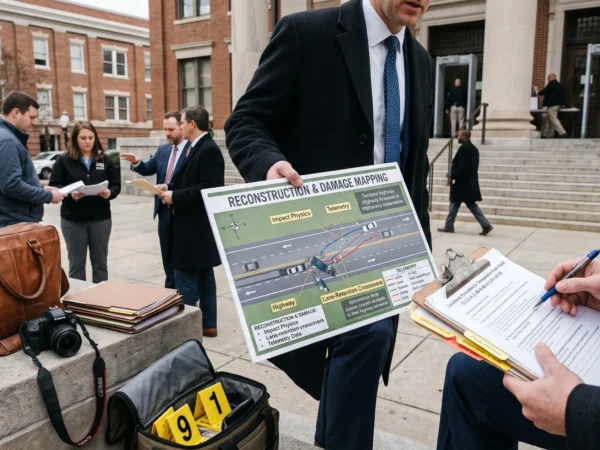
Head-on crashes are reconstructed from physical and electronic evidence, often before the vehicles are repaired or destroyed:
- Event data recorders that capture speed, braking, and steering in the seconds before impact.
- Scene evidence: gouge marks, tire marks, debris fields, and where the vehicles came to rest relative to the center line.
- Phone records and toxicology to prove distraction or impairment.
- Video and witnesses, including dashcams, nearby businesses, and 911 calls reporting a wrong-way driver.
The defense may claim a sudden emergency, such as a tire blowout or a medical event, or argue that the injured driver shared the blame. Under OCGA § 51-12-33, a jury divides fault, reduces an award by the injured person’s share, and bars recovery at 50 percent or more. As of publication, juries in lawsuits filed on or after April 21, 2025, may also hear evidence about seat belt use (OCGA § 40-8-76.1), which makes biomechanical evidence about how the injuries happened more important.
The Injuries Head-On Crashes Cause
Head-on collisions combine the speeds of both vehicles, and the results are often catastrophic: traumatic brain injuries, spinal cord injuries, a fractured femur or crushed lower legs, chest and internal organ injuries, and burns. When a crash is fatal, the family may bring a wrongful death claim for the full value of the life (OCGA § 51-4-2); see Recovery for Wrongful Death Types.
Deadlines
Most Georgia injury lawsuits must be filed within two years (OCGA § 9-3-33). When the at-fault driver is charged with a crime, such as DUI or vehicular homicide, OCGA § 9-3-99 generally pauses the injured victim’s deadline while the prosecution is pending, for up to six years; as of publication, however, the Court of Appeals has held that a family’s wrongful death claim does not receive that pause (Hicks v. Universal Health Services, 2022). If a road defect or government vehicle contributed, written ante litem notice may be due within 12 months for the state (OCGA § 50-21-26) or six months for a city (OCGA § 36-33-5). Preserve the vehicles right away, because their data can be lost when they are salvaged.
What a Head-On Collision Case Is Worth
Value is driven by the severity and permanence of the injuries, lifetime medical and care costs, lost earning capacity, and pain and suffering. Punitive damages may be available on clear and convincing evidence of willful misconduct or an entire want of care, and when the at-fault driver was impaired by alcohol or drugs, Georgia’s usual $250,000 cap on punitive damages does not apply (OCGA § 51-12-5.1).
Insurance often sets the practical ceiling, so it matters to find every policy: the at-fault driver’s liability and umbrella coverage, any employer or dram shop defendant’s coverage, and your own uninsured/underinsured motorist coverage. Insurers must disclose their policy limits in response to a proper written request (OCGA § 33-3-28); see personal injury insurance. As of publication, Georgia’s 2025 tort reform law also lets juries consider what was actually paid for medical care (OCGA § 51-12-1.1) and limits how lawyers may suggest noneconomic damages amounts (OCGA § 9-10-184). Our attorneys believe parts of that law will ultimately be ruled unconstitutional under the Georgia Constitution’s guarantee of the right to trial by jury.
What Others Say About Our Work
Expertise.com named Haug Barron Law Group among the Best Car Accident Lawyers in Roswell. I hold an AV Preeminent® rating from Martindale-Hubbell and have been selected to Super Lawyers® each year since 2024, after Rising Star recognition from 2017 through 2023. Other Georgia law firms refer cases to Haug Barron Law Group for litigation, and my law partner, Colin A. Barron, and I obtained a $30 million wrongful death verdict in DeKalb County State Court. Every case is different, and no prior result predicts the outcome of another.
“I could not be happier with my experience with this law group…”
— Erika F., Google review (auto accident client), March 2026
Hurt in a Head-On or Wrong-Way Crash? Free Consultation
After a head-on collision, take these steps as soon as you can:
- Get medical care, and follow up even if some symptoms appear later.
- Keep the police report number and any information about criminal charges.
- Ask that both vehicles be preserved so their data can be downloaded.
- Don’t give a recorded statement to any insurer before talking to a lawyer.
If you or a loved one was seriously injured or killed in a head-on or wrong-way crash in Georgia, a plaintiff-only trial firm that moves quickly to preserve vehicle data, reconstruct the collision, and pursue every responsible party can protect your right to full compensation. Contact Haug Barron Law Group today for a free, confidential consultation — no fee unless we win.
This article provides general information about Georgia law and is not legal advice. It does not create an attorney-client relationship. Past results do not guarantee future outcomes. Advertising does not indicate a guarantee of results. © Haug Barron Law Group, Personal Injury Lawyers. All rights reserved.
Contact Haug Barron Law Group Today for a FREE Consultation.