
Proving the Owner “Knew”: How Georgia Premises Liability Claims Actually Work
For the basic definition, see our glossary entry on premises liability. This article is about what actually decides these cases in Georgia: proof of what the owner knew, how that proof is built, the deadlines that protect it, and how it shapes value. For an overview of the cases we handle, see our Premises Liability practice page.
| The Short Answer |
|---|
| In Georgia, getting hurt on someone else’s property is not enough to win a premises liability claim. You generally must prove the owner knew or should have known about the hazard, and that you did not know about it despite using ordinary care. That proof, from inspection records and video to prior complaints, drives what the case is worth, and most claims must be filed within two years. |
The Legal Test: Who Knew More About the Danger?
Georgia law requires an owner or occupier to use ordinary care to keep the premises and approaches safe for invitees, such as customers, tenants, and guests invited for business (OCGA § 51-3-1). Licensees are owed less: protection from willful or wanton injury (OCGA § 51-3-2), and trespassers are owed less still (OCGA § 51-3-3).
For invitees, the Supreme Court of Georgia framed the core question in Robinson v. Kroger Co. (1997) as one of superior knowledge. You must show two things: that the owner had actual or constructive knowledge of the hazard, and that you lacked knowledge of it despite exercising ordinary care for your own safety, often because of something the owner did or failed to do. The same decision recognized that whether an injured person used ordinary care is usually a question for a jury, not a reason to throw the case out early.
How “Should Have Known” Is Proven
Actual knowledge is the easy version: a prior complaint, an email about the leak, a manager who saw the spill. Most cases turn on constructive knowledge, which Georgia courts recognize in two main ways:
- An employee was nearby. A staff member was in the immediate area and could easily have seen and fixed the hazard.
- The hazard was there long enough. The condition existed long enough that a reasonable inspection would have found it. That makes the owner’s inspection procedures, and whether anyone actually followed them, central evidence.
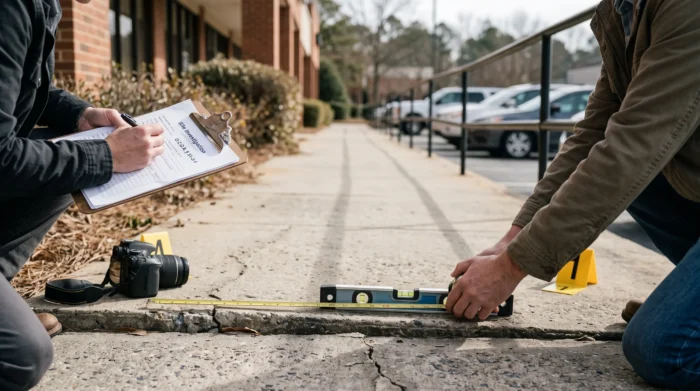
The evidence that proves knowledge usually sits with the owner: sweep and inspection logs, surveillance video, incident reports, maintenance work orders, prior complaints and similar incidents, staffing records, and building-code or safety-standard violations that a qualified expert can explain. Our glossary entries on slip and fall and negligent maintenance of premises describe the most common fact patterns.
That second route is where many cases are won or lost. In Johnson v. All American Quality Foods, Inc., 340 Ga. App. 664, 798 S.E.2d 274 (2017), which my law partner, Colin A. Barron, and I won on appeal, a shopper slipped in liquid that had leaked from packaged meat. The store inspected hourly, had logged an inspection of the aisle about 38 minutes before the fall, and won summary judgment in the trial court. The full Court of Appeals reversed. It held that a store seeking summary judgment must show not only that it had a reasonable inspection program but that the program was actually carried out, that the injured person does not have to prove how long the hazard was there until the store makes that showing, and that whether an hourly inspection was reasonable for a supermarket was a question for the jury.
How the Defense Uses Your Own Conduct
Expect the owner to argue that the hazard was “open and obvious” or that you should have been watching where you walked. Georgia law does not require a visitor to stare at the floor at every step, and distractions the owner created, such as displays or poor lighting, can explain why you did not see the danger. Fault can still be shared: under OCGA § 51-12-33, your recovery is reduced by your percentage of fault and barred if you are 50 percent or more responsible.
Injuries From Crime: Negligent Security After 2025
When a person is attacked on a property, the claim is for negligent security. For incidents on or after April 21, 2025, Georgia’s 2025 tort reform law placed these claims in a new statutory framework (OCGA § 51-3-50 et seq.). The injured invitee must show the crime was reasonably foreseeable, generally through a particularized warning, prior similar wrongful conduct the owner knew about, or a specific physical condition of the property that created a substantially greater risk. The jury must also apportion fault to the person who committed the crime. These cases now demand early, detailed investigation of the property’s history.
Deadlines and the Race to Preserve Evidence
Most Georgia premises liability lawsuits must be filed within two years of the injury (OCGA § 9-3-33). If the property belongs to a city, county, or the state, written ante litem notice may be required much sooner; for a city, the deadline is six months (OCGA § 36-33-5).
The practical deadline is shorter. Many surveillance systems record over footage within days or weeks. Georgia courts can sanction a party that destroys evidence once litigation is reasonably foreseeable, but the strongest protection is a written preservation demand sent right away, identifying the video, logs, and records the owner must keep.
What a Georgia Premises Liability Case Is Worth
Damages follow the same rules as other injury cases: proven special damages such as medical expenses and lost income, and general damages for pain and suffering (OCGA § 51-12-2). What makes premises cases different is how strongly value depends on the knowledge proof. A case with video, ignored inspection logs, or prior incidents is worth far more than one that rests on the injured person’s account alone, because the risk of losing before trial is lower.
Coverage matters too. Businesses usually carry commercial general liability insurance, and its limits often shape the practical range of a settlement. Punitive damages are available only on clear and convincing evidence of willful misconduct or an entire want of care (OCGA § 51-12-5.1). As of publication, Georgia’s 2025 tort reform law also lets juries consider what was actually paid for medical care (OCGA § 51-12-1.1) and limits how lawyers may suggest noneconomic damages amounts (OCGA § 9-10-184). Our attorneys believe parts of that law will ultimately be ruled unconstitutional under the Georgia Constitution’s guarantee of the right to trial by jury.
What Others Say About Our Work
In premises cases, the most direct proof is the Johnson decision described above, in which the full Court of Appeals reversed a grocery store’s summary judgment and sent our client’s case to a jury.
I hold an AV Preeminent® rating from Martindale-Hubbell and have been selected to Super Lawyers® each year since 2024, after Rising Star recognition from 2017 through 2023. Other Georgia law firms refer cases to Haug Barron Law Group for litigation when those cases cannot be resolved before suit. My law partner, Colin A. Barron, and I obtained a $30 million wrongful death verdict in DeKalb County State Court. Every case is different, and no prior result predicts the outcome of another.
“…the firm worked diligently and achieved a successful outcome.”
— Karolina H., Google review, October 2025
Hurt on Someone Else’s Property? Free Consultation
If you were injured on a property in Georgia, take these steps:
- Get medical care, and tell the provider exactly how you were hurt.
- Photograph the hazard, the area, lighting, and any warning signs, or their absence.
- Report the injury to a manager, ask for a copy of the report, and get witnesses’ names.
- Keep the shoes and clothing you wore, and don’t give a recorded statement to the owner’s insurer before talking to a lawyer.
If you were injured on someone else’s property in Georgia, winning depends on proving what the owner knew or should have known about the hazard, and a plaintiff-only firm that moves quickly to preserve video, inspection logs, and prior-incident evidence can hold negligent property owners accountable. Contact Haug Barron Law Group today for a free, confidential consultation to protect your legal rights.
This article provides general information about Georgia law and is not legal advice. It does not create an attorney-client relationship. Past results do not guarantee future outcomes. Advertising does not indicate a guarantee of results. © Haug Barron Law Group, Personal Injury Lawyers. All rights reserved.
Contact Haug Barron Law Group Today for a FREE Consultation.