
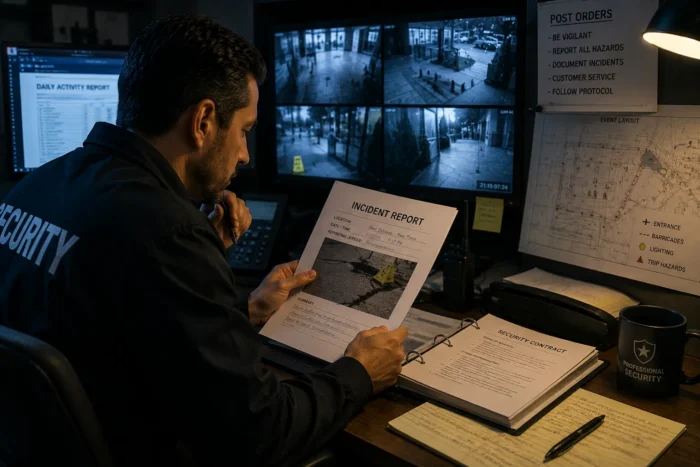
Georgia Security Contractor Liability for Trip-and-Fall Accidents: How Restatement § 324A Protects Injured Airport Visitors
Introduction: When Security Guards Cause Trip-and-Fall Injuries at Georgia Airports
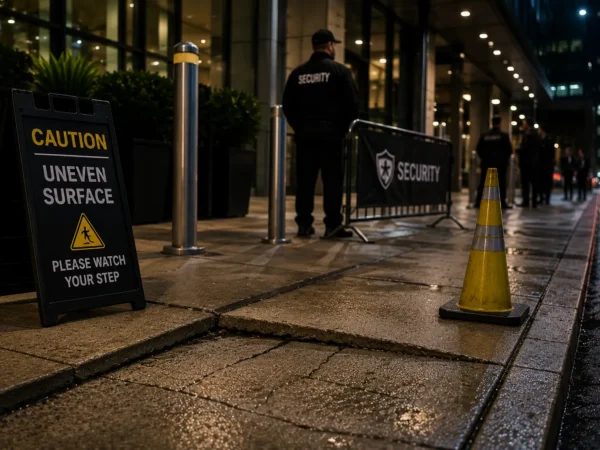
Airport Trip & Fall Liability GA: Every year, thousands of Georgians are seriously injured in preventable slip-and-fall and trip-and-fall accidents at Georgia’s airports, shopping centers, and public venues — many caused not by the property owner but by the negligence of third-party security contractors hired to keep those spaces safe.
When a security company fails to do its job and someone is catastrophically injured or killed as a result, the law may hold that contractor fully accountable.
At Haug Barron Law Group, Personal Injury Lawyers, we are recognized as one of Georgia’s leading plaintiff-only personal injury firms. Our founding partner, James R. Haug, and managing partner, Colin A. Barron, have taken cases to trial against the most well-funded corporate defendants — and won. Our $30 million wrongful death verdict in DeKalb County stands as one of the most significant plaintiff verdicts in recent Georgia history. When you need to hold a negligent security contractor — or any negligent party — accountable, HBLG is the firm that fights for you.
What Is Restatement § 324A and Why Does It Matter for Injured Georgians?
When most people think of premises liability in Georgia, they think of the property owner’s duty under O.C.G.A. § 51-3-1 to keep their property reasonably safe for invited guests. But what happens when a third-party contractor — such as a security company — creates or fails to correct a dangerous condition? That’s where Restatement (Second) of Torts § 324A comes in.
Section 324A imposes liability on any party who voluntarily undertakes a duty to render services necessary for the protection of a third person, and then negligently performs (or fails to perform) that duty. Under § 324A, the injured party need only prove one of three conditions:
- (a) The contractor’s failure to exercise reasonable care increased the risk of harm;
- (b) The contractor undertook to perform a duty owed by the property owner to the injured person; or
- (c) The injured person or the property owner relied upon the contractor’s undertaking.
Georgia courts, including the Georgia Supreme Court, have confirmed that § 324A applies to security contractors. In Ga. CVS Pharm., LLC v. Carmichael, 316 Ga. 718, 719 (2023), the Supreme Court held that a party rendering security services to a proprietor may owe a duty of care to third parties visiting the premises under § 324A.
How Does a Security Contractor’s Duty Arise Under § 324A?
The classic common-law rule is that a bystander has no legal duty to help a stranger in danger. But that rule changes the moment a party takes action. As Justice Cardozo wrote, the hand once set to a task may not always be withdrawn with impunity. H.R. Moch Co. v. Rensselaer Water Co., 247 N.Y. 160, 167 (1928).
In the security contractor context, this means:
- Training documents that instruct guards to inspect for and remove trip hazards can establish an assumed duty
- Contracts requiring the contractor to upkeep assigned areas and control their equipment create a basis for liability
- Testimony from guards confirming they were trained to look for trip hazards and keep walkways safe can establish the undertaking
- Evidence that guards actually performed these inspections at the incident location helps prove reliance
Critically, under Georgia law, § 324A liability can arise from omissions — not just affirmative acts. A contractor that was trained to inspect for trip hazards but failed to do so may be just as liable as one that actively created the hazard. Urban Servs. Grp., Inc. v. Royal Grp., Inc., 295 Ga. App. 350, 352 (2008).
Three Legal Pathways to Recovery Under § 324A
Pathway A: Increased Risk of Harm
Under § 324A(a), the key question is whether the contractor’s conduct left the injured person in a worse position than if the contractor had never acted at all. Herrington v. Gaulden, 294 Ga. 285, 288 (2013). If a security contractor placed mats in a hidden or high-traffic area of an airport concourse, moved them around repeatedly, and then failed to inspect the area on the day of the incident, it may have increased the risk of harm to passersby — satisfying this subsection.
Pathway B: Performing the Property Owner’s Duty
Under § 324A(b), a security contractor that takes over aspects of the property owner’s day-to-day safety obligations — such as inspecting walkways for hazards and controlling its own equipment — can independently be held liable for common-law negligence in performing those functions. Camelot Club Condo. Ass’n v. Afari-Opoku, 340 Ga. App. 618, 628 (2017). Notably, the property owner’s duty as landowner remains non-delegable, but the contractor’s independent assumption of that duty creates a separate basis for liability.
Pathway C: Reliance
Under § 324A(c), liability arises where the injury was suffered because of reliance — either by the property owner or by the injured person — on the contractor’s undertaking. Georgia’s Supreme Court has made clear that proof of reliance is not burdensome: a victim can prove personal reliance simply through testimony about their experience watching security personnel maintain safe walkways, combined with their reasonable expectation that trained security professionals were performing their jobs. Universal Underwriters Ins. Co. v. Smith, 253 Ga. 588, 591–592 (1984).
Key Georgia Cases Supporting § 324A Claims Against Security Contractors
- Ga. CVS Pharm., LLC v. Carmichael, 316 Ga. 718 (2023) — Georgia Supreme Court blessed § 324A’s application to security contractors, holding they may owe a duty to third parties.
- Urban Servs. Grp., Inc. v. Royal Grp., Inc., 295 Ga. App. 350 (2008) — Georgia Court of Appeals rejected the argument that only affirmative acts (not omissions) create § 324A liability, confirming that failure to inspect can be actionable.
- Monitronics Int’l, Inc. v. Veasley, 323 Ga. App. 126 (2013) — Affirmed denial of directed verdict where jury could find contractor’s own communications showed it undertook a safety duty.
- Universal Underwriters Ins. Co. v. Smith, 253 Ga. 588 (1984) — Georgia Supreme Court confirmed that victim’s reliance can be established through personal testimony alone.
- Huggins v. Aetna Cas. & Sur. Co., 245 Ga. 248 (1980) — Held that employer/property owner reliance is alone sufficient to sustain a § 324A claim, even without personal reliance by the victim.
Why Haug Barron Law Group Is Georgia’s Premier Choice for Catastrophic Injury and Wrongful Death Cases
“We took the case to trial and won $30 million for our clients. When corporations put profits over people’s safety, Haug Barron Law Group goes to the courtroom and fights.” — James R. Haug, Founding Partner
At Haug Barron Law Group, Personal Injury Lawyers, we do one thing: fight for seriously injured people and the families of those who have been killed due to someone else’s negligence. We are not a general practice firm. We do not represent insurance companies or corporate defendants. We are 100% plaintiff-focused — and that singular focus has produced results that speak for themselves.
| Why Choose HBLG | Our Track Record |
|---|---|
| Plaintiff-Only Firm — We Never Represent Insurance Companies AV Preeminent® Rated Attorney (Martindale-Hubbell’s Highest Rating) Georgia Super Lawyers® — Rising Star Through 2024; Super Lawyer 2025–Present Member, Georgia Trial Lawyers Association (GTLA) Member, AAJ Trucking Litigation Group Offices in Atlanta, Sandy Springs & Decatur, GA | $30 Million Wrongful Death Verdict — DeKalb County Multiple Additional Million-Dollar Verdicts and Settlements Extensive Trial Experience Against Well-Funded Corporate Defendants Catastrophic Injury │ Wrongful Death │ Trucking │ Premises Liability │ Medical Malpractice |
Our Practice Areas: Serious Cases for Seriously Injured Clients
- Wrongful Death — Georgia’s most rigorous and emotionally devastating cases
- Catastrophic and Traumatic Injury — Brain injuries, spinal cord injuries, amputations, severe burns
- Commercial Trucking Collisions — FMCSA violations, black box data, carrier liability
- Premises Liability — Trip-and-fall, slip-and-fall, negligent security
- Medical Malpractice — Cancer misdiagnosis, surgical errors, birth injuries
- Daycare and Child Injury — Negligent supervision, abuse, dangerous facilities
- Airport and Security Contractor Liability — Including § 324A undertaking claims
Injured in a Trip-and-Fall at a Georgia Airport or Venue?
Visit our Personal Injury FAQs to learn about premises liability, security contractor negligence, Georgia’s comparative fault rules, and what compensation you may recover after a serious injury caused by a negligent property owner or contractor.
If you or a loved one was seriously injured in a trip-and-fall accident at a Georgia airport, mall, or public venue caused by the negligence of a security contractor, a plaintiff-only firm that understands the complex liability theories under Restatement § 324A — and has the trial record to prove them in court — is your strongest ally in holding every responsible party fully accountable. Contact Haug Barron Law Group today for a free, confidential consultation — no fee unless we win.
James R. Haug is the Founding Partner of Haug Barron Law Group, Personal Injury Lawyers, a plaintiff-only personal injury firm based in Atlanta, Georgia. He holds an AV Preeminent® rating from Martindale-Hubbell — the highest possible peer review rating for legal ability and ethical standards. Mr. Haug was recognized as a Georgia Super Lawyers® Rising Star through 2024 and has been named a Georgia Super Lawyer® as of 2025. He is an active member of the Georgia Trial Lawyers Association (GTLA) and the AAJ Trucking Litigation Group. Mr. Haug has secured multiple million-dollar verdicts and settlements for his clients, including a $30 million wrongful death verdict in DeKalb County, Georgia, obtained jointly with Managing Partner Colin A. Barron. Haug Barron Law Group exclusively represents injured plaintiffs in catastrophic injury and wrongful death cases throughout Georgia.
Disclaimer: This article is for general informational purposes only and does not constitute legal advice. Reading this article does not create an attorney-client relationship. Every case is different. Contact Haug Barron Law Group at (844) 428-4529 or www.hblg.law to discuss the specific facts of your situation with a licensed Georgia personal injury attorney.
Contact Haug Barron Law Group Today for a FREE Consultation.