
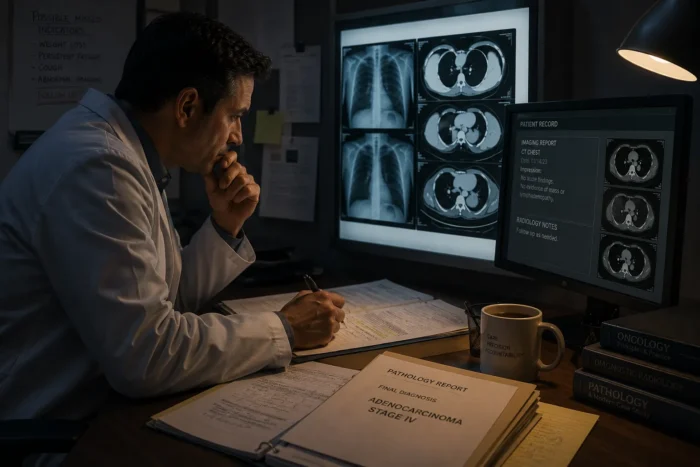
Failure to Diagnose Cancer in Georgia: What Victims and Families Can Recover
When a Doctor Misses Cancer — Your Life, Your Rights, Your Recovery

A cancer diagnosis is devastating. A missed, delayed, or wrong cancer diagnosis can be catastrophic — and it may be the result of medical malpractice. In Georgia, thousands of patients each year are harmed when physicians, radiologists, pathologists, or other healthcare providers fail to identify cancer at a stage when it was still treatable.
If this has happened to you or someone you love, you may be entitled to substantial financial compensation under Georgia law.
Haug Barron Law Group, Personal Injury Lawyers is widely recognized as one of Georgia’s premier plaintiff’s personal injury firms. We exclusively represent injured patients and their families — never hospitals, never insurance companies, never defendants. With offices in Atlanta, Sandy Springs, and Decatur, our trial attorneys have secured multiple multi-million dollar verdicts and settlements for medical malpractice victims throughout the state, including a landmark $30 million verdict in DeKalb County. We have the resources, the record, and the relentless advocacy that cancer misdiagnosis victims deserve.
What Is Failure to Diagnose Cancer? Georgia’s Legal Standard
Under Georgia medical malpractice law, a healthcare provider is negligent when they fail to act as a reasonably competent provider in their specialty would have acted under similar circumstances. Applied to cancer diagnosis, this means a physician, radiologist, pathologist, or specialist may be liable when they:
- Miss a tumor or suspicious mass on an imaging scan (X-ray, CT, MRI, PET scan, or ultrasound)
- Fail to follow up on abnormal lab results or biopsy findings
- Dismiss or minimize a patient’s reported symptoms that are textbook cancer warning signs
- Misread or misinterpret a pathology specimen or biopsy slide
- Fail to order appropriate diagnostic testing when cancer is clinically indicated
- Neglect to refer a patient to an oncologist or specialist in a timely manner
- Attribute cancer symptoms to a benign condition without adequate workup
Georgia law provides cancer misdiagnosis victims with the right to pursue damages under O.C.G.A. § 51-1-27, which holds healthcare providers to the standard of care in their medical community. Claims must generally be filed within two years of the date the negligence was discovered or reasonably should have been discovered, subject to an absolute five-year statute of repose under O.C.G.A. § 9-3-71. An attorney experienced in Georgia medical malpractice law is essential to protect your rights before these deadlines expire.
Common Cancers Involved in Georgia Misdiagnosis Cases
Our firm handles failure-to-diagnose claims involving virtually every type of cancer. The most frequently litigated include:
- Breast Cancer — Missed mammogram findings, delayed biopsy referrals, and misread MRI results cause preventable late-stage diagnoses
- Colorectal Cancer — Failure to order colonoscopy for patients with chronic symptoms or positive fecal occult blood tests
- Lung Cancer — Nodules dismissed on chest X-ray or CT scan; delayed follow-up imaging
- Prostate Cancer — Failure to act on rising PSA levels or abnormal digital rectal exam findings
- Cervical & Ovarian Cancer — Abnormal Pap smears not properly followed up; pelvic masses dismissed
- Melanoma & Skin Cancer — Suspicious lesions biopsied late or misread as benign by pathology
- Pancreatic Cancer — Delayed workup of abdominal pain, weight loss, or jaundice
- Brain & Spinal Tumors — Headaches and neurological symptoms attributed to less serious conditions
- Leukemia & Lymphoma — Abnormal complete blood counts ignored or inadequately evaluated
- Thyroid Cancer — Nodules not biopsied; abnormal thyroid function tests not acted upon
What Damages Can Georgia Cancer Misdiagnosis Victims Recover?
Georgia law permits victims of medical negligence to pursue a broad array of compensatory damages. In wrongful death cases involving cancer, the law allows the surviving family to recover the “full value of the life” of the decedent under O.C.G.A. § 51-4-2.
Economic (Special) Damages
- All past and future medical expenses related to the cancer, including surgery, chemotherapy, radiation, immunotherapy, hospital stays, and palliative care
- Lost wages and earning capacity — including future income the patient would have earned had cancer been caught at an earlier, more treatable stage
- The cost of additional medical procedures required due to the delay — such as more aggressive chemotherapy or surgery that would not have been necessary with timely diagnosis
- Home health care, in-home assistance, and rehabilitation costs
Non-Economic (General) Damages
- Physical pain and suffering throughout delayed diagnosis, treatment, and terminal illness
- Emotional distress, anxiety, and the psychological trauma of receiving a late-stage cancer diagnosis
- Loss of enjoyment of life and the inability to participate in activities, relationships, and milestones
- Loss of consortium — the impact on the patient’s marital relationship and family bonds
Wrongful Death Damages
When a failure to diagnose cancer causes a patient’s death, Georgia’s Wrongful Death Act (O.C.G.A. § 51-4-1 et seq.) permits the surviving spouse, children, or parents to recover the “full value of the life” of the deceased person. This is one of the broadest wrongful death recovery standards in the nation. Georgia courts have upheld multi-million dollar verdicts where delayed cancer diagnosis cost a patient their life.
Punitive Damages
In rare cases involving egregious or reckless conduct — such as a physician who repeatedly ignored clear cancer indicators over months or years — Georgia law may allow the jury to award punitive damages under O.C.G.A. § 51-12-5.1. Punitive damages are designed to punish the wrongdoer and deter similar misconduct.
Why Georgia Patients Need an Experienced Malpractice Attorney
Georgia medical malpractice cases are among the most complex in personal injury litigation. Unlike a standard car accident case, a cancer misdiagnosis claim requires qualified medical expert witnesses under O.C.G.A. § 24-7-702 who must practice in the same specialty as the defendant provider; a thorough review of medical records spanning years of treatment; mastery of medical literature establishing the standard of care for cancer screening and diagnosis; expert radiology, pathology, and oncology review to establish what a competent provider would have seen and done differently; and detailed economic analysis to calculate the full scope of lost income and future medical costs.
Georgia also requires a sworn expert affidavit (O.C.G.A. § 9-11-9.1) to be filed with or shortly after the complaint in any medical malpractice case. Missing this procedural requirement can result in dismissal. At Haug Barron Law Group, we have the experience, expert network, and litigation infrastructure to prosecute complex cancer malpractice cases from investigation through trial.
Proving a Cancer Misdiagnosis Case: What Must Be Established
Duty of Care
A physician-patient relationship existed, creating a legal duty for the provider to render care consistent with the accepted standard.
Breach of the Standard of Care
The provider’s conduct fell below what a reasonably competent healthcare professional in the same specialty would have done — for example, a radiologist who missed a 2-centimeter lung nodule that should have prompted immediate follow-up.
Causation
The breach caused measurable harm. In cancer cases, this typically means expert testimony establishing that timely diagnosis would have resulted in a higher survival rate, less aggressive treatment, or a meaningful extension of life expectancy.
Damages
Quantifiable injury resulted — including advanced-stage cancer requiring more radical treatment, physical suffering, financial losses, or wrongful death.
Statute of Limitations: Do Not Wait
Time is critical in Georgia medical malpractice cases. Under O.C.G.A. § 9-3-71, you generally have two years from the date the negligent act occurred, or the date you discovered (or reasonably should have discovered) the malpractice, whichever is earlier. A hard five-year statute of repose bars all claims regardless of discovery. In wrongful death cases, the two-year period typically runs from the date of the patient’s death. If you suspect a missed or delayed cancer diagnosis — even if you are not certain — contact a Georgia medical malpractice attorney immediately.
Have Questions About a Cancer Misdiagnosis Claim in Georgia?
Visit our Cancer Misdiagnosis FAQs to learn about Georgia’s standard of care, what damages you can recover, the statute of limitations, and your legal rights after a delayed or missed cancer diagnosis causes serious harm.
If your loved one was killed due to the negligence of a Georgia government entity — whether a city vehicle, a dangerous public road, a public school, or a state-run facility — the ante litem deadlines are unforgiving and the procedural requirements are exacting, making it critical to retain a plaintiff-only firm with the trial record and government liability experience to navigate every obstacle and hold the responsible parties fully accountable. Contact Haug Barron Law Group today for a free, confidential consultation — no fee unless we win.
This article is for general informational and educational purposes only. It does not constitute legal advice and does not create an attorney-client relationship. Every case is unique, and past results do not guarantee future outcomes. Georgia medical malpractice law is subject to change. Consult a licensed Georgia attorney for advice specific to your situation.
Contact Haug Barron Law Group Today for a FREE Consultation.