
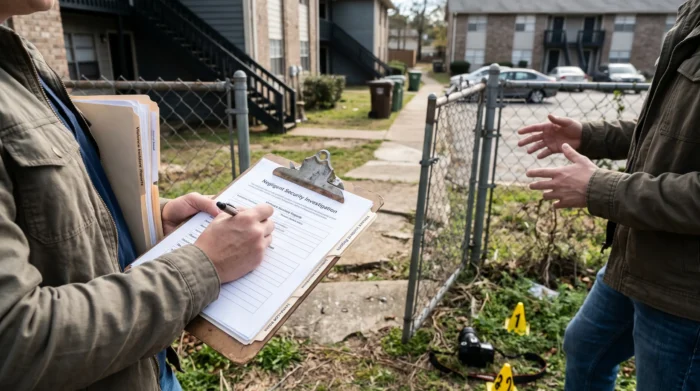
Negligent Security in Georgia: When an Apartment Complex or Business Is Liable for a Violent Attack
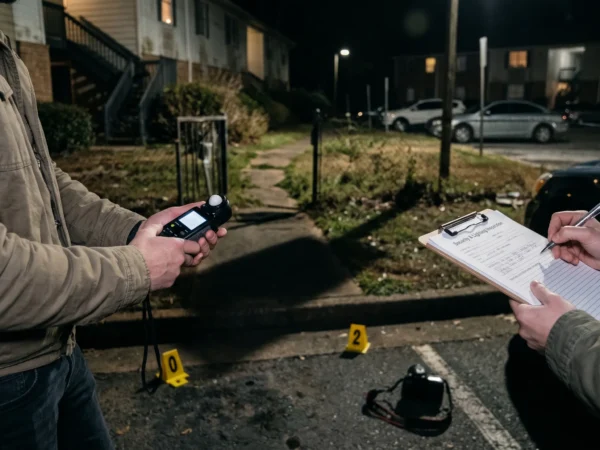
For the basic definition, see our glossary entry on negligent security. This article covers what decides these cases in Georgia today: the 2025 statute, the evidence that proves foreseeability, the deadlines, and what drives value. For an overview of the cases we handle, see our Premises Liability practice page.
| The Short Answer |
|---|
| In Georgia, an apartment complex or business can be liable for a violent attack on its property when the attack was foreseeable and the owner failed to use ordinary care to address the danger. For attacks on or after April 21, 2025, a new statute generally requires proof that the owner had a specific warning or actually knew of prior, substantially similar crimes on or near the property. Most claims must be filed within two years, though the deadline can be paused while a criminal case is pending. |
The 2025 Law: Georgia’s New Negligent Security Statute
Georgia’s 2025 tort reform law created a separate framework for these claims (OCGA § 51-3-50 et seq.), which applies to injuries on or after April 21, 2025. For a customer, tenant, or other invitee, the statute generally requires proof that:
- The attack was foreseeable. The owner had a particularized warning of imminent wrongful conduct, or actually knew of prior, substantially similar wrongful conduct on the premises, on adjoining property, or within 500 yards. Prior conduct by the same attacker can also qualify in some circumstances.
- The injury was a foreseeable result of that conduct.
- A condition of the property played a role. The attack was connected to a known condition of the premises that created a higher-than-usual risk, such as a broken gate, dark parking lot, or failed access control.
- The owner failed to use ordinary care to address that condition, and that failure was a proximate cause of the injury.
“Substantially similar” is defined by the nature, dangerousness, location, timing, and circumstances of the prior crimes, so a history of car break-ins may not make an armed robbery foreseeable. Licensees face a narrower path, and the statute protects an owner who received a particularized warning and made reasonable efforts to notify law enforcement.
For attacks before April 21, 2025, Georgia’s earlier case law under OCGA § 51-3-1 still governs. It also centered on prior substantially similar crimes, as the Supreme Court of Georgia explained in Sturbridge Partners, Ltd. v. Walker (1997), but without the new statute’s specific requirements.
How Negligent Security Is Proven
Under the new statute, the case usually turns on what the owner actually knew and when. The evidence that proves it includes:
- Police call records for the property and the surrounding 500 yards, along with incident reports and offense data.
- The owner’s own records: tenant complaints, security-guard logs, emails with management companies, and prior incident reports.
- Physical-condition proof: repair requests for gates, locks, lighting, and cameras, and when each was reported and fixed.
- Security-expert testimony on what reasonable measures would have been and whether they would have prevented the attack.
Much of this evidence is in the owner’s hands, and some of it, such as video and access-control data, can be overwritten within days. A written preservation demand should go out immediately.
These cases are frequently fought at summary judgment, where the owner argues there is not enough proof to reach a jury. In Johnson v. All American Quality Foods, Inc., 340 Ga. App. 664 (2017), a premises case my law partner, Colin A. Barron, and I won on appeal, the full Court of Appeals reversed summary judgment for a store and held that the owner had to prove its safety procedures were actually carried out.
How Fault Is Divided
The person who committed the attack is always at fault. Under the 2025 law, the jury must apportion fault among the owner, the attacker, and anyone else responsible, and the court must order a new trial if it does not. Under OCGA § 51-12-33, the owner then pays only its percentage. Value therefore depends on how strongly the evidence shows the owner’s failures made the attack possible.
Deadlines for Negligent Security Claims
Most Georgia injury claims must be filed within two years (OCGA § 9-3-33). When the injury came from a crime, OCGA § 9-3-99 pauses the injured victim’s deadline while the prosecution is pending, for up to six years, and the Court of Appeals has applied that pause to claims against property owners who were not charged with the crime (Harrison v. McAfee, 2016). As of publication, however, the Court of Appeals has held that a family bringing a wrongful death claim does not receive that pause (Hicks v. Universal Health Services, 2022). If the property is owned by a city or another public body, written ante litem notice may be due within six months (OCGA § 36-33-5). Because the safest course is to treat two years as the deadline, talk to a lawyer early.
What a Negligent Security Case Is Worth
Shootings, stabbings, and assaults often cause severe injuries, including brain and spinal injuries and lasting psychological trauma such as PTSD. Damages include medical expenses, lost income, and pain and suffering. When an attack is fatal, the family may bring a wrongful death claim for the full value of the life (OCGA § 51-4-2); see Recovery for Wrongful Death Types.
Three factors shape value in these cases. First is the share of fault the jury assigns to the owner. Second is insurance: many commercial policies exclude or sharply limit coverage for assaults, so identifying every policy, including those of management and security companies, matters. Third is the strength of the knowledge evidence. Punitive damages may be sought where clear and convincing evidence shows willful misconduct or an entire want of care (OCGA § 51-12-5.1).
As of publication, Georgia’s 2025 tort reform law also lets juries consider what was actually paid for medical care (OCGA § 51-12-1.1) and limits how lawyers may suggest noneconomic damages amounts (OCGA § 9-10-184). Our attorneys believe parts of that law will ultimately be ruled unconstitutional under the Georgia Constitution’s guarantee of the right to trial by jury.
What Others Say About Our Work
My law partner, Colin A. Barron, and I obtained a $30 million wrongful death verdict in DeKalb County State Court. Every case is different, and no prior result predicts the outcome of another. I hold an AV Preeminent® rating from Martindale-Hubbell and have been selected to Super Lawyers® each year since 2024, after Rising Star recognition from 2017 through 2023. Other Georgia law firms refer cases to Haug Barron Law Group for litigation when those cases cannot be resolved before suit.
“…they helped me greatly during the whole process.”
— Dalton C., Google review, October 2026
Attacked at an Apartment Complex or Business? Free Consultation
If you or a family member was attacked on someone else’s property in Georgia, take these steps:
- Get medical care, and keep every record.
- Keep the police report number and the names of officers and witnesses.
- Photograph lighting, gates, locks, and cameras at the scene, and save any complaints you made to management.
- Don’t give a recorded statement to the owner’s insurer before talking to a lawyer.
If you or a loved one was seriously injured in a violent attack at a Georgia apartment complex or business, a plaintiff-only firm that investigates the property’s crime history, preserves critical security evidence, and holds negligent owners accountable can protect your legal rights and your recovery. Contact Haug Barron Law Group today for a free, confidential consultation — no fee unless we win.
This article provides general information about Georgia law and is not legal advice. It does not create an attorney-client relationship. Past results do not guarantee future outcomes. Advertising does not indicate a guarantee of results. © Haug Barron Law Group, Personal Injury Lawyers. All rights reserved.
Contact Haug Barron Law Group Today for a FREE Consultation.