
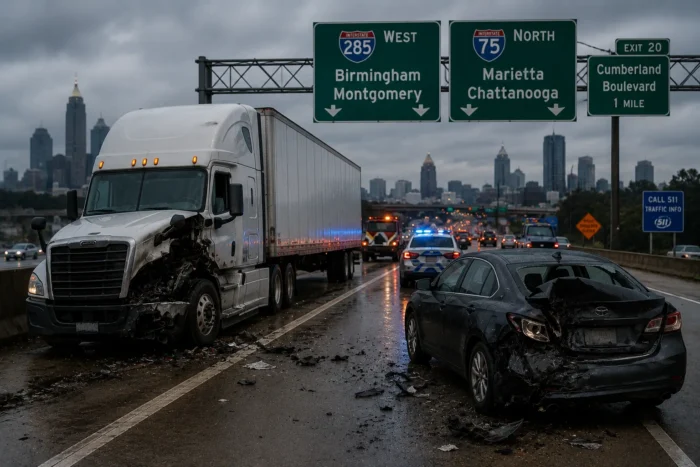
I-285 and I-75 Truck Accident Hotspots in Georgia: What Drivers Need to Know
Overview: Georgia’s Deadliest Trucking Corridors
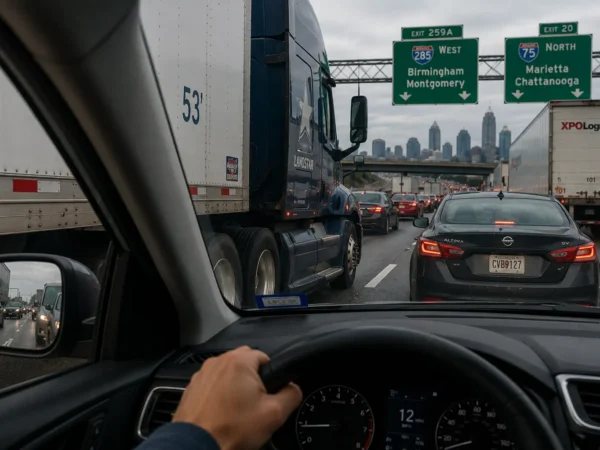
I-285 & I-75 GA Truck Accident Hotspots: Georgia’s Interstate 285 and Interstate 75 form two of the most commercially active and statistically dangerous highway corridors in the American Southeast.
Together, these roads carry tens of thousands of tractor-trailers, flatbeds, tankers, and oversize loads daily through metro Atlanta and deep into the Georgia heartland — creating catastrophic collision risks that have ended lives, destroyed families, and cost survivors everything.
If you or a loved one was seriously injured or killed in a truck accident on I-285, I-75, or any connected Georgia roadway, the award-winning legal team at Haug Barron Law Group, Personal Injury Lawyers stands ready to fight for the compensation you deserve. As Georgia’s premier plaintiff-only personal injury and wrongful death firm, we have the litigation experience, resources, and relentless advocacy that insurance companies fear.
I-285: The Perimeter — A Ring Road Plagued by Truck Crashes
Geography and Traffic Profile
Interstate 285 — locally known as “The Perimeter” — is a 64-mile loop encircling metro Atlanta through Cobb, Fulton, DeKalb, and Clayton counties. Originally designed to divert through traffic from downtown Atlanta, I-285 has evolved into one of the busiest urban freight arteries in the United States. According to the Georgia Department of Transportation (GDOT), sections of I-285 carry in excess of 200,000 vehicles per day, with commercial truck traffic representing a disproportionate share — particularly near major interchanges with I-75, I-85, I-20, and SR 400.
High-Crash Zones on I-285
Data from the Georgia Governor’s Office of Highway Safety and GDOT crash records consistently identify the following I-285 segments as catastrophic-crash hotspots:
- I-285 & I-75 Interchange (Northwest Quadrant, Cobb/Fulton County Line) — One of the most freight-intensive intersections in Georgia, this area sees regular jackknife incidents, underride crashes, and multi-vehicle pileups, particularly at merge/diverge points where speed differentials are extreme.
- I-285 & I-85 South Interchange (College Park / Hapeville, Fulton/Clayton Counties) — Heavy cargo traffic serving Hartsfield-Jackson Atlanta International Airport creates a volatile mix of oversized loads, airport logistics vehicles, and passenger traffic.
- I-285 & I-20 West Interchange (Douglasville/Lithia Springs Access, Douglas County) — An increasingly congested segment where runaway truck incidents and rear-end crashes involving large commercial vehicles have been documented.
- I-285 & SR 400 / GA-400 Interchange (Sandy Springs, Fulton County) — High-speed merging in proximity to dense commercial development creates frequent sideswipe and lane-change collisions involving 18-wheelers.
- I-285 & I-20 East Interchange (DeKalb County) — Near Decatur and Stone Mountain access corridors, gradient changes and sight-line challenges contribute to truck brake failures and override incidents.
Why I-285 Is So Dangerous for Trucking
- The Perimeter was designed in an era when commercial truck sizes and weights were far smaller than today’s 80,000-lb semi-trucks.
- Multiple grade changes, tight entrance/exit geometries, and short merge lanes create excessive demand on truck braking systems.
- 24-hour freight movement means fatigued truck drivers are navigating complex interchanges at all hours.
- Construction zones are nearly constant along I-285, narrowing lanes and changing traffic patterns without adequate warning for heavy vehicles.
I-75: The Appalachian-to-Florida Freight Spine Through Georgia
Geography and Commercial Traffic
Interstate 75 traverses Georgia from the Tennessee border near Dalton in Whitfield County south through metro Atlanta and continues through Macon, Warner Robins, Valdosta, and ultimately to the Florida state line — covering approximately 355 miles of Georgia highway. The corridor functions as the primary north-south freight route for the entire Eastern Seaboard, connecting Midwestern manufacturing hubs to Florida distribution centers. The Federal Motor Carrier Safety Administration (FMCSA) estimates that I-75 through Georgia handles millions of commercial vehicle miles traveled annually, making it one of the most truck-dense routes in the nation.
High-Crash Zones on I-75
- I-75 & I-285 Northwest Interchange (Cobb County / Cumberland) — The intersection of both featured corridors creates one of the single highest-risk trucking collision points in the state.
- I-75 Downtown Atlanta Connector (Fulton/DeKalb Counties) — Elevated sections near the I-75/I-85 split are among the most dangerous in the country due to extreme traffic density, no emergency shoulders, and lane widths incompatible with modern semi-truck dimensions.
- I-75 Macon Corridor (Bibb County) — A well-documented stretch where GDOT’s own crash data shows disproportionately high commercial vehicle fatal crash rates due to high speed, long grades, and drowsy driving.
- I-75 Exits 319–333 (Henry County / Stockbridge) — Rapid suburban development has created dangerous speed differentials between local passenger vehicles and through freight traffic.
- I-75 South of Atlanta to Valdosta (Tift, Crisp, Turner, Lowndes Counties) — Long unbroken stretches of rural I-75 are notorious for hours-of-service violations by truckers pressured to make Florida delivery windows, leading to drowsy driving fatalities.
- I-75 Near Dalton (Whitfield County) — The carpet industry capital of the world generates enormous outbound truck traffic on I-75 northbound; overloaded vehicles and grade-change rollover incidents are documented recurring events.
Georgia Legal Framework for Truck Accident Claims
Applicable Statutes
Truck accident litigation in Georgia is governed by an interlocking framework of state tort law and federal motor carrier regulations. Key statutes include:
- O.C.G.A. § 51-1-6 — Georgia’s general negligence statute establishing civil liability for violation of legal duties.
- O.C.G.A. § 51-12-5.1 — Georgia’s punitive damages statute, critical in cases involving reckless conduct such as hours-of-service violations or DUI trucking cases.
- O.C.G.A. § 40-1-1 et seq. — Georgia’s Motor Carrier Act, incorporating FMCSA safety regulations into state law.
- O.C.G.A. § 51-4-1 et seq. — Georgia’s Wrongful Death Act, permitting the surviving spouse, children, or parents to recover the “full value of the life” of the deceased.
- O.C.G.A. § 9-3-33 — Georgia’s two-year statute of limitations for personal injury claims. Do not wait.
- 49 C.F.R. Parts 390–399 — Federal Motor Carrier Safety Regulations (FMCSR) — governing hours of service, vehicle maintenance, driver qualifications, cargo securement, and electronic logging devices (ELDs).
- MCS-90 Endorsement (49 C.F.R. § 387.15) — The federal MCS-90 endorsement requires minimum liability coverage for interstate motor carriers and may provide a direct recovery avenue against an insurer even when a carrier claims the driver was an independent contractor.
Controlling Georgia Case Law and Courts
Georgia courts have developed a substantial body of law governing truck accident liability, respondeat superior, and punitive damages. Key venues where Haug Barron Law Group litigates these matters include the DeKalb County State Court — one of the most active venues for truck accident and catastrophic injury litigation in metro Atlanta, and the court where James R. Haug and Colin A. Barron jointly obtained the landmark $30 million wrongful death verdict in the Butler case — as well as the Fulton County State Court, Cobb County State Court, Clayton County State Court, Gwinnett County State Court, Bibb County State Court (Macon), Henry County State Court (McDonough), and the United States District Court for the Northern District of Georgia (Atlanta Division) for federal diversity cases.
Landmark Georgia appellate decisions shaping modern truck accident practice include Bloodworth v. Hicks, 364 Ga. App. 165 (2022) — addressing liability standards for trucking companies under respondeat superior; Werner Enterprises, Inc. v. Stanton, 319 Ga. App. 839 (2013) — establishing the scope of independent contractor liability in trucking; and Mastec North America, Inc. v. Wilson, 325 Ga. App. 698 (2014) — articulating punitive damages standards in catastrophic commercial vehicle cases.
Authoritative Government & Research Resources
- Georgia Department of Transportation (GDOT) — Official crash data, traffic counts, construction zone records, and road condition reports for I-285 and I-75.
- Georgia Governor’s Office of Highway Safety (GOHS) — Georgia-specific fatal and serious injury crash statistics by highway, county, and vehicle type.
- Federal Motor Carrier Safety Administration (FMCSA) — Carrier safety ratings, BASIC scores, inspection histories, crash data, and out-of-service orders for any licensed motor carrier.
- National Transportation Safety Board (NTSB) — Investigates and publishes reports on significant commercial trucking accidents nationwide, including Georgia incidents.
- Georgia State Patrol (GSP) — Prepares crash reports (SR-18 forms) for all reportable accidents on Georgia interstates; critical evidence in truck accident litigation.
- Georgia Department of Public Safety (DPS) — Oversees commercial vehicle enforcement and motor carrier compliance in Georgia.
- Georgia Tech Institute for Transportation Research (STRIDE Center) — Georgia Institute of Technology’s leading transportation research center providing academic data on crash causation and infrastructure safety.
- University of Georgia Transportation Safety Research Program — Academic analysis of rural highway safety issues directly applicable to I-75 south Georgia trucking corridors.
- National Highway Traffic Safety Administration (NHTSA) — Publishes the Fatality Analysis Reporting System (FARS) with Georgia-specific heavy vehicle fatality data.
- Georgia’s Liability Insurance Verification System (ELVIS) — State tool confirming insurance compliance for motor carriers registered in Georgia.
Why Haug Barron Law Group Is Georgia’s Top Choice for Truck Accident Victims
When a catastrophic trucking crash on I-285 or I-75 changes your life forever, you need more than a lawyer — you need a legal team that has consistently delivered life-changing results for Georgia’s most seriously injured accident victims. Haug Barron Law Group, Personal Injury Lawyers is that firm.
Unmatched Track Record
- $30 Million Wrongful Death Verdict in DeKalb County State Court — obtained jointly by James R. Haug and Colin A. Barron — one of the largest such verdicts in DeKalb County history.
- Multiple seven-figure and eight-figure settlements and verdicts in trucking, catastrophic injury, and wrongful death cases.
- Numerous multi-million dollar medical verdicts across Georgia’s State Court system.
Award-Winning Leadership
James R. Haug, Founding Partner, holds an AV Preeminent® rating from Martindale-Hubbell — the highest possible rating for legal ability and ethical standards, earned by fewer than 10% of American attorneys. He has been selected to the Georgia Super Lawyers® list for 2025 — the highest peer-recognition distinction — having previously been recognized as a Super Lawyers® Rising Star through 2024. He is a member of the Georgia Trial Lawyers Association (GTLA) and the American Association for Justice (AAJ) — Trucking Litigation Section.
Plaintiff-Only Firm — Your Interests Always Come First
Unlike firms that represent both plaintiffs and insurance companies, Haug Barron Law Group is exclusively a plaintiff’s firm. We have never represented an insurance company, a trucking company, or a corporate defendant. Our singular focus is on maximizing compensation for injured victims and the families of those killed by negligent drivers.
Dedicated Trucking Litigation Expertise
- Electronic Logging Device (ELD) data extraction and hours-of-service violation analysis.
- Black box / Event Data Recorder (EDR) download protocols and expert interpretation.
- FMCSA CSA BASIC score analysis and carrier negligent entrustment claims.
- Preservation letters and spoliation doctrine — sent immediately upon retention to protect critical evidence.
- Expert witness networks in accident reconstruction, biomechanics, trucking operations, and medical economics.
- Freight broker liability under 49 U.S.C. § 13102 and the Carmack Amendment framework.
Frequently Asked Questions: I-285 & I-75 Truck Accidents in Georgia
The following questions represent the most-searched topics by Georgia residents injured — or who have lost family members — in commercial trucking crashes on I-285, I-75, and connecting corridors.
What should I do immediately after a truck accident on I-285 or I-75 in Georgia?
Seek emergency medical treatment first — call 911 and remain at the scene. Your health is the priority. Once safe, do not admit fault or apologize to the truck driver or their employer. Request that Georgia State Patrol respond and file a crash report (SR-18). Photograph the scene, vehicles, cargo, road conditions, and visible injuries. Obtain the trucker’s CDL, motor carrier number (DOT/MC), insurance information, and the trucking company’s contact details. Preserve your clothing and any damaged personal property. Contact an experienced Georgia truck accident attorney as soon as possible — ideally the same day. Evidence disappears fast in trucking cases. Haug Barron Law Group responds to new truck accident cases 24/7. Call (844) HAUG-LAW immediately.
How long do I have to file a truck accident lawsuit in Georgia?
Under O.C.G.A. § 9-3-33, you generally have two years from the date of the accident to file a personal injury lawsuit in Georgia. For wrongful death claims under O.C.G.A. § 51-4-2, the two-year clock typically runs from the date of death. However, critical evidence — including black box data, ELD records, cell phone records, and driver logs — can be destroyed or overwritten within days. Georgia’s spoliation doctrine does not automatically protect this evidence. You must act immediately. If a government entity owns or maintains the roadway, a notice of claim may be required within 12 months or less. Never wait.
Who can be held liable for a truck accident on I-285 or I-75 in Georgia?
Truck accident liability in Georgia is rarely limited to just the driver. Potentially responsible parties include the truck driver (for negligent, reckless, or impaired driving, fatigue, distracted driving, or hours-of-service violations); the trucking company (under respondeat superior if the driver is an employee, or under negligent entrustment/hiring/supervision/retention if a contractor); the freight broker (under an expanding line of federal and Georgia case law recognizing broker liability for selecting unsafe carriers); the cargo shipper or loader (if improperly secured cargo caused the accident); the truck manufacturer or parts supplier (if a brake failure, tire blowout, or mechanical defect caused the crash); a maintenance or repair company (if negligent servicing contributed to mechanical failure); and GDOT or a local government (if dangerous road conditions, missing signage, or design defects contributed, subject to Georgia Tort Claims Act requirements). Identifying all responsible parties is one of the most critical tasks in truck accident litigation — Haug Barron Law Group conducts thorough investigations to ensure every liable party is held accountable.
What is the MCS-90 endorsement and how does it affect my Georgia truck accident claim?
The MCS-90 endorsement is a federally mandated insurance provision under 49 C.F.R. § 387.15 that requires interstate motor carriers to maintain minimum levels of liability coverage. The MCS-90 can obligate a carrier’s insurer to pay a judgment even if the carrier claims the driver was an independent contractor, not an employee. This is a critical protection for victims — it prevents trucking companies from using contractor designations to escape financial responsibility. At Haug Barron Law Group, we regularly analyze MCS-90 triggers and other insurance coverage issues to maximize recovery for our clients.
My family member was killed in a truck accident on I-75 in Georgia. Do we have a wrongful death claim?
Yes. Under O.C.G.A. § 51-4-2, the surviving spouse, children, or — if none — parents, may file a wrongful death action seeking the “full value of the life” of the deceased, including both economic and non-economic components. Georgia’s wrongful death statute is among the most expansive in the nation. The estate may separately pursue a survival action for the decedent’s pain and suffering, medical bills, and funeral expenses. Haug Barron Law Group has obtained a $30 million wrongful death verdict in DeKalb County State Court — obtained jointly by James R. Haug and Colin A. Barron — and has settled numerous wrongful death trucking cases for seven- and eight-figure amounts. We handle these cases with the sensitivity and ferocity the gravity of the loss demands.
What damages can I recover after a catastrophic truck accident in Georgia?
Georgia law permits recovery of both economic and non-economic damages. In cases of intentional, willful, or reckless conduct, punitive damages are also available under O.C.G.A. § 51-12-5.1. Recoverable damages include past and future medical expenses (surgery, hospitalization, rehabilitation, in-home care); lost wages and future loss of earning capacity; physical pain and suffering; emotional distress and mental anguish; loss of enjoyment of life; permanent disfigurement, disability, or impairment; property damage; spousal loss of consortium; and punitive damages in cases of drunk driving, falsified logs, known mechanical defects ignored, or gross recklessness. Trucking companies carry multi-million dollar insurance policies — Haug Barron Law Group fights to recover every dollar available under all applicable policies.
How do I get the truck driver’s black box and ELD data after an I-285 or I-75 crash?
Electronic control modules (ECMs), event data recorders (EDRs), and electronic logging device (ELD) data can prove speeding, sudden braking, hours-of-service violations, and more. However, this data is routinely overwritten within 30 days — sometimes within days — unless preserved. Haug Barron Law Group sends spoliation and preservation letters to trucking companies and their insurers on the day of retention, demanding immediate preservation of all electronic and paper records. We also work with certified accident reconstruction experts and forensic data specialists to download and interpret this critical evidence. Do not wait to hire an attorney — every day of delay risks permanent evidence loss.
The truck driver said I was partially at fault. Does that bar my Georgia claim?
No. Georgia follows a modified comparative fault rule under O.C.G.A. § 51-12-33. As long as you are less than 50% responsible for the accident, you may still recover damages — though your recovery will be reduced by your percentage of fault. Trucking companies and their insurance adjusters routinely attempt to shift blame to the injured victim to reduce or eliminate their liability. Haug Barron Law Group‘s attorneys aggressively contest improper fault apportionment and build the evidentiary record to establish the trucker’s primary negligence.
Where are Georgia truck accident lawsuits filed?
In Georgia, personal injury and wrongful death lawsuits are filed in the State Courts of the county where the defendant resides or where the cause of action arose. Key State Courts for I-285 and I-75 trucking cases include the DeKalb County State Court, Fulton County State Court, Cobb County State Court, Clayton County State Court, Gwinnett County State Court, and Bibb County State Court (Macon). Federal cases involving out-of-state trucking companies may be filed in the U.S. District Court for the Northern District of Georgia (Atlanta Division). Haug Barron Law Group is experienced in both state and federal trucking litigation.
The trucking company’s insurance adjuster called me. Should I talk to them?
No. Do not speak with the trucking company’s insurance adjuster without an attorney present. Adjusters are trained to minimize claims and will use anything you say to reduce or deny your compensation. Statements made to an adjuster — even innocent, casual remarks — can be used against you. Politely decline to provide a recorded statement and refer them to your attorney. At Haug Barron Law Group, we handle all communications with insurance companies on your behalf from day one.
Can I sue a freight broker if a broker hired an unsafe trucking company that caused my crash?
Yes, under an expanding body of federal and Georgia case law. Freight brokers who negligently select motor carriers with poor safety histories can be held liable under a theory of negligent selection or negligent hiring. Courts have recognized that brokers have a duty to vet the carriers they retain. Developments in Georgia appellate courts and federal cases have broadened the landscape for broker liability. Haug Barron Law Group actively litigates freight broker cases and includes broker liability analysis as part of every commercial trucking case investigation.
How much does it cost to hire Haug Barron Law Group for a Georgia truck accident case?
Nothing upfront. Haug Barron Law Group handles all personal injury and wrongful death cases on a contingency fee basis — meaning you pay no attorney fees unless and until we recover compensation for you. We also advance all case costs, including expert witness fees, accident reconstruction costs, medical record retrieval, and court filing fees. If we do not win, you owe us nothing. There is no financial risk in calling us.
What if the truck driver was intoxicated or under the influence of drugs at the time of the crash?
If a commercial truck driver was operating under the influence of alcohol, illegal drugs, or impairing prescription medications, Georgia law permits recovery of punitive damages under O.C.G.A. § 51-12-5.1. In DUI trucking cases, the trucking company may also face direct liability for negligently retaining or supervising a driver with a known substance abuse history. FMCSA drug and alcohol testing requirements under 49 C.F.R. Part 382 impose strict obligations on carriers — violations are powerful evidence of corporate negligence. Haug Barron Law Group has extensive experience pursuing punitive damages claims in DUI trucking cases.
What are hours-of-service (HOS) violations and how do they affect my truck accident claim?
Federal hours-of-service regulations (49 C.F.R. Part 395) limit the number of consecutive hours a commercial truck driver may operate without mandatory rest periods. Violations — such as driving beyond the 11-hour daily limit or failing to take mandatory 10-hour off-duty breaks — are a leading cause of drowsy driving fatalities on I-285 and I-75. HOS violations documented through ELD records, driver logs, or fuel receipts can constitute negligence per se under Georgia law and dramatically strengthen a victim’s claim. Haug Barron Law Group‘s attorneys know exactly where to look for this evidence and how to use it.
My injury from an I-285 truck crash was a traumatic brain injury (TBI) or spinal cord injury (SCI). Are these cases handled differently?
Catastrophic injury cases involving traumatic brain injuries, spinal cord injuries, paralysis, amputations, and severe burns require a higher level of evidentiary and damages work than typical personal injury claims. Haug Barron Law Group specializes in these cases. We work with leading neurologists, neurosurgeons, life care planners, vocational rehabilitation experts, and economists to build comprehensive damages models that account for the full lifetime cost of a catastrophic injury — often millions of dollars in future medical care, lost earnings, and loss of quality of life. Our firm has secured seven-figure and eight-figure results in catastrophic injury cases and knows how to present the full human and economic cost of these injuries to a jury.
Can I still file a claim if the truck accident happened months ago and I did not immediately hire a lawyer?
Yes — provided Georgia’s statute of limitations has not expired (generally two years from the date of the crash under O.C.G.A. § 9-3-33). However, the longer you wait, the greater the risk that critical evidence has been destroyed. ELD and black box data may already be gone. Witness memories fade. Crash scenes change. Call Haug Barron Law Group today for a free consultation — we will honestly assess the current state of available evidence and the viability of your claim.
If you or a loved one was seriously injured — or killed — in a commercial truck accident on I-285, I-75, or any connecting Georgia corridor, black box data, ELD records, and other critical evidence can disappear within days, making it essential to retain a plaintiff-only trucking litigation firm with AAJ Trucking Section membership, a $30 million wrongful death verdict, and the trial record to hold every responsible party — driver, carrier, broker, and beyond — fully accountable. Contact Haug Barron Law Group today for a free, confidential consultation — no fee unless we win.
This article is provided for general informational and educational purposes only and does not constitute legal advice. No attorney-client relationship is created by reading this content. Each case is unique and past results do not guarantee future outcomes. The information contained herein is based on Georgia law as of the date of publication and is subject to change. For advice specific to your situation, consult a licensed Georgia attorney.
Contact Haug Barron Law Group Today for a FREE Consultation.