
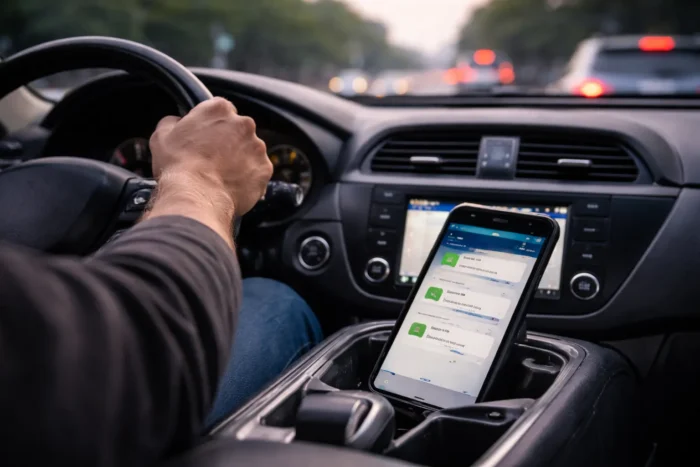
Distracted Driving Accidents in Georgia: Texting, Apps, and Liability
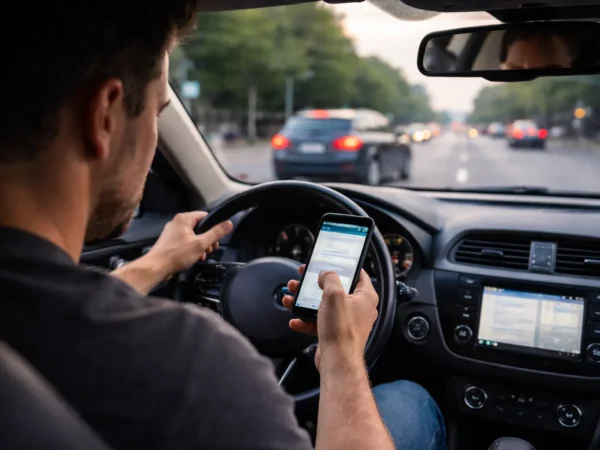
Distracted Driving Accidents in GA: If you were injured in a car accident caused by a distracted driver in Georgia, you may be entitled to significant financial compensation. Every year, thousands of Georgians are seriously hurt — and hundreds are killed — because another driver chose to look at a phone instead of the road.
These crashes are entirely preventable, and the drivers who cause them can and should be held accountable.
At Haug Barron Law Group, Personal Injury Lawyers, our Atlanta-based legal team represents victims of distracted driving accidents throughout Georgia. We fight exclusively on behalf of injured people — never insurance companies, never defendants. If a distracted driver turned your life upside down, we want to help you get justice.
What Is Distracted Driving?
Distracted driving is any activity that diverts a driver’s attention from the primary task of operating a vehicle safely. The Centers for Disease Control and Prevention (CDC) divides distractions into three categories:
- Visual distractions — taking your eyes off the road (reading a text, checking a map)
- Manual distractions — taking your hands off the wheel (typing, eating, adjusting the radio)
- Cognitive distractions — taking your mind off driving (talking on the phone, daydreaming, emotional distress)
Texting while driving is the most dangerous because it combines all three simultaneously. According to the National Highway Traffic Safety Administration (NHTSA), sending or reading a text takes a driver’s eyes off the road for an average of five seconds. At 55 mph, that is the equivalent of driving the entire length of a football field completely blind.
Georgia’s Distracted Driving Laws
Georgia has enacted some of the strictest distracted driving laws in the country. Understanding them matters, because a driver who violates these laws may be presumed negligent in a civil lawsuit — which can directly strengthen your injury claim.
The Hands-Free Georgia Act (O.C.G.A. § 40-6-241)
Effective July 1, 2018, Georgia’s Hands-Free Georgia Act prohibits drivers from:
- Holding or using a phone or stand-alone electronic device while driving
- Writing, sending, or reading any text-based communication (texts, emails, social media messages, web pages)
- Watching or recording video while operating a vehicle
- Reaching for a device in a way that requires leaving the seat or unsecured seating position
The law applies to all drivers on Georgia roads, regardless of speed, traffic conditions, or whether the vehicle is stopped at a red light. Drivers may only use their phone through voice-to-text commands, Bluetooth, a hands-free speakerphone, or a device mounted to the windshield or dashboard.
First offenses carry a $50 fine and 1 point on the driver’s license. Second offenses result in a $100 fine and 2 points. Third and subsequent offenses jump to a $150 fine and 3 points. While these fines are modest, a driver who receives a citation creates a paper trail that your attorney can use as evidence of negligence in a civil case.
Other Relevant Georgia Traffic Laws
Beyond the Hands-Free Act, Georgia’s general reckless and careless driving statutes also apply to distracted drivers. Under O.C.G.A. § 40-6-390 (reckless driving), a driver who operates a vehicle with willful or wanton disregard for the safety of others can face enhanced civil liability. Evidence of egregious distraction — such as a driver who was streaming video, posting to social media, or had dozens of unread notifications — can support a claim for punitive damages under O.C.G.A. § 51-12-5.1.
Most Common Causes of Distracted Driving Accidents in Georgia
While texting gets most of the headlines, distracted driving takes many forms. Our attorneys at Haug Barron Law Group regularly handle cases involving:
Texting and Smartphone Use
Text messaging remains the most common and most dangerous form of distracted driving. This includes SMS messages, iMessage, WhatsApp, Snapchat, Instagram DMs, and every other messaging platform. Even a glance at a notification can be enough to cause a catastrophic crash.
Navigation Apps
GPS and navigation apps like Google Maps and Waze are useful tools, but manipulating them while driving is illegal in Georgia if the phone is not mounted. Drivers who are inputting destinations, scrolling maps, or zooming in on routes are visually, manually, and cognitively distracted.
Social Media Scrolling and Posting
Scrolling through TikTok, Instagram, Facebook, or Twitter while behind the wheel is a growing cause of severe accidents. Some drivers go so far as to record and post videos while driving. If the at-fault driver was on social media at the time of the crash, their account activity and phone records can often be subpoenaed to prove distraction.
Video Streaming
Watching YouTube, Netflix, Hulu, or other streaming services while driving is explicitly banned under Georgia’s Hands-Free law. Crashes caused by streaming-related distraction often involve high speeds and a complete failure to brake, resulting in the most catastrophic injuries.
Hands-Free Calls and Cognitive Distraction
Even hands-free calls are not free from risk. Research from the AAA Foundation for Traffic Safety has shown that voice-activated technology and hands-free calling still create significant cognitive distraction. While hands-free use is legal in Georgia, evidence of a phone call at the time of the crash can support an argument that the driver was not fully attentive.
In-Vehicle Infotainment Systems
Modern vehicles come equipped with large touchscreen displays for climate, audio, and navigation. Drivers who are fiddling with these systems — particularly those requiring multiple taps or swipes — take their eyes and attention off the road for dangerous lengths of time.
How Liability Works in a Georgia Distracted Driving Accident
Georgia follows a modified comparative fault rule under O.C.G.A. § 51-12-33. As long as you are less than 50% at fault for an accident, you can still recover compensation — though your award may be reduced by your percentage of fault. This rule makes it critical to work with an experienced personal injury attorney who can gather evidence, counter insurance company arguments about your role in the crash, and maximize your recovery.
To win a distracted driving accident case in Georgia, your attorney must prove four elements:
- Duty: The at-fault driver owed you a duty of care to operate their vehicle safely and follow Georgia traffic laws.
- Breach: The driver breached that duty by engaging in distracted behavior while driving.
- Causation: Distracted driving directly caused the collision and your injuries.
- Damages: You suffered actual, measurable harm as a result — medical bills, lost income, pain and suffering, and more.
Evidence Your Attorney Will Gather
One of the most important things your attorney can do in a distracted driving case is move quickly to preserve and obtain critical evidence. At Haug Barron Law Group, we act fast because evidence disappears — and insurance companies know it.
- Phone records and carrier data: Call logs, text timestamps, and data usage records can pinpoint exactly what the driver was doing on their phone at the moment of impact. These records require a subpoena and must be requested before carriers purge them.
- Traffic and surveillance camera footage: Cameras at intersections, businesses, and highway systems may have captured the collision. Footage is often overwritten within days.
- Event data recorder (“black box”) data: Many modern vehicles record speed, braking, and steering inputs in the seconds before a crash. This data can corroborate witness accounts and contradict an at-fault driver’s story.
- Social media records: Posts, Stories, and activity logs can show that the driver was actively using social media at the time of the accident.
- Witness statements: Passengers, bystanders, and other drivers may have seen the at-fault driver looking at their phone before impact.
- Police report: Officers who respond to the scene sometimes note driver admissions or cite the Hands-Free Act. The report is a foundational piece of evidence.
Damages Available to Distracted Driving Accident Victims in Georgia
Economic Damages
- Emergency room bills, hospitalization, surgery, and ongoing medical treatment
- Physical therapy, rehabilitation, and future medical care
- Lost wages from time missed at work
- Loss of earning capacity if your injuries affect your ability to work long-term
- Property damage to your vehicle
- Out-of-pocket expenses such as transportation to medical appointments
Non-Economic Damages
- Physical pain and suffering
- Emotional distress and mental anguish
- Loss of enjoyment of life
- Disfigurement or permanent scarring
- Loss of consortium (impact on your relationship with your spouse)
Punitive Damages
Under O.C.G.A. § 51-12-5.1, Georgia courts may award punitive damages in cases where the defendant’s conduct was willful, wanton, fraudulent, or showed conscious indifference to the consequences of their actions. Deliberately using a phone while driving — particularly streaming video, posting on social media, or texting — can meet this threshold. There is generally no cap on punitive damages in Georgia motor vehicle cases.
What If the Distracted Driver Was Working at the Time?
If the distracted driver was operating a vehicle for work purposes when the crash occurred — making deliveries, driving a company car, responding to work messages, or performing any job-related duty — their employer may also be liable under the legal doctrine of respondeat superior. This can significantly expand the pool of available insurance coverage, particularly for commercial vehicles, delivery drivers, rideshare drivers, and truckers.
Georgia courts have also considered whether an employer could be independently liable for negligent entrustment or negligent supervision if the company knew or should have known that an employee used their phone while driving and failed to enforce a safe driving policy.
Dealing With the Insurance Company After a Distracted Driving Accident
Insurance companies know that distracted driving cases can result in large verdicts. Their adjusters are trained to minimize your claim from the moment they learn of the crash. Common tactics include:
- Contacting you quickly after the accident, before you have legal representation, to get a recorded statement they can use against you
- Offering a fast, lowball settlement before the full extent of your injuries is known
- Arguing that you were partly at fault for the accident
- Claiming your injuries are not as serious as you report, or were pre-existing
Do not give a recorded statement to any insurance company — including your own — before speaking with an attorney. At Haug Barron Law Group, our consultations are free, and we handle all communications with insurers on your behalf.
Uninsured and Underinsured Motorist Coverage in Distracted Driving Cases
Even if the distracted driver who hit you has minimal insurance or no insurance at all, you may still be able to recover fair compensation through your own Uninsured/Underinsured Motorist (UM/UIM) coverage. Georgia law requires insurers to offer UM/UIM coverage, and many drivers are unaware of just how valuable this protection can be.
If the at-fault driver’s insurance is insufficient to cover your losses, your UM/UIM policy steps in to fill the gap. Our attorneys have extensive experience handling UM/UIM claims and can help you access every available dollar.
How Much Is a Distracted Driving Accident Case Worth?
There is no single answer — the value of your case depends on the severity of your injuries, the strength of the evidence of distraction, the available insurance coverage, and how your life has been affected. Cases involving serious injuries such as traumatic brain injury, spinal cord damage, broken bones, or permanent disability consistently result in higher verdicts and settlements.
What we can tell you is that injured victims who hire an experienced personal injury attorney consistently recover more than those who try to navigate the claims process alone. Insurance companies negotiate differently when they know a skilled trial lawyer is involved.
At Haug Barron Law Group, we handle distracted driving cases on a contingency fee basis — meaning you pay nothing unless we win. There are no upfront costs, no hourly fees, and no out-of-pocket expenses for your representation.
Why Choose Haug Barron Law Group?
Haug Barron Law Group, Personal Injury Lawyers is a plaintiff-only personal injury firm based in Atlanta, Georgia. We represent injured people — period. We never represent insurance companies, corporations, or defendants. When you work with Haug Barron Law Group, you can expect:
- Aggressive advocacy: We investigate every aspect of your case, preserve critical evidence, and are fully prepared to take your case to trial if the insurer refuses to pay fair value.
- Transparent communication: You will always know the status of your case, what to expect at each stage, and what your options are.
- No upfront costs: We work on a contingency fee basis. You pay nothing unless we recover money for you.
- Plaintiff-only focus: We have never represented an insurance company or a defendant. Our experience is built entirely on helping injured people win.
Steps to Take After a Distracted Driving Accident in Georgia
- Call 911. Make sure police respond to the scene and file an official report.
- Document everything. Take photos and video of the vehicles, the scene, road conditions, any injuries, and the positions of the cars after impact.
- Get witness information. Names and phone numbers of anyone who saw the crash — or who saw the driver on their phone — can be invaluable.
- Seek immediate medical care. Even if you feel okay, see a doctor as soon as possible. Some serious injuries, including concussions and internal trauma, do not present symptoms immediately. A gap in medical treatment can be used against you.
- Avoid social media. Do not post about the accident on any platform. Insurance adjusters and defense attorneys routinely monitor injured plaintiffs’ social media accounts.
- Contact a personal injury attorney before speaking with any insurer. Your first call should be to a lawyer, not an adjuster.
Have questions about distracted driving accident claims?
Visit our Georgia Car Accident FAQs to learn how texting and app use impact liability, what evidence matters, and how these cases are proven.
Distracted driving accidents involving texting and apps can create clear evidence of negligence under Georgia law. Contact Haug Barron Law Group to discuss your case and pursue full compensation.
Disclaimer: This article is for general informational purposes only and does not constitute legal advice. Reading this content does not create an attorney-client relationship with Haug Barron Law Group. The outcome of any legal matter depends on the specific facts and circumstances of each case. If you have been injured in a car accident, please consult with a qualified Georgia personal injury attorney.
Contact Haug Barron Law Group Today for a FREE Consultation.