

T-Bone Collisions at Intersections: Who Bears Fault in Georgia?
When a T-Bone Crash Changes Everything
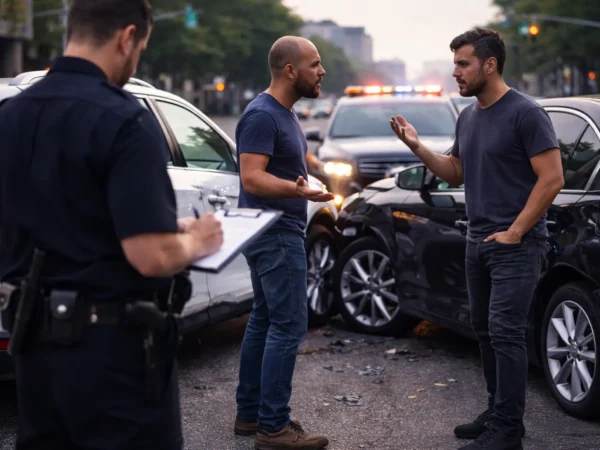
T-Bone Collisions: Fault in Georgia: A broadside collision — commonly called a T-bone crash — ranks among the most dangerous types of accidents that occur on Georgia roads. Unlike a rear-end impact, a T-bone strike delivers the full force of one vehicle into the door panels and side windows of another.
There are no crumple zones on the door of a sedan. There is no meaningful buffer between the striking vehicle’s bumper and a passenger’s head, chest, or pelvis. The results are frequently catastrophic: traumatic brain injuries, fractured pelvises, ruptured organs, spinal cord damage, and fatalities.
If you or a family member has been hurt in a T-bone collision in Atlanta, Sandy Springs, Decatur, or anywhere else in Georgia, the most important question you are likely asking is: who is at fault, and can I recover compensation? This article answers both questions in depth. Understanding how Georgia’s fault rules work at intersections, what evidence matters most, and why the insurance company’s first offer is almost never its best offer will help you make an informed decision about your rights.
Why T-Bone Crashes Are So Deadly
Side-impact collisions are disproportionately lethal. The National Highway Traffic Safety Administration (NHTSA) consistently reports that side impacts account for roughly one-quarter of all occupant fatalities in passenger vehicle crashes. The physics are straightforward: the striking vehicle’s bumper and hood absorb little energy before reaching the occupant compartment. Even with modern side curtain airbags, the intrusion of a heavy pickup truck or SUV into a sedan’s door can reach the center console in milliseconds.
The Insurance Institute for Highway Safety (IIHS) has documented that the risk of death in a side-impact crash is significantly higher when the striking vehicle is taller and heavier — a growing concern as pickup trucks and large SUVs increasingly dominate Georgia’s roads. A broadside hit at an Atlanta metro intersection can be lethal even at moderate speeds.
Common Injuries in T-Bone Accidents
Because the side door offers minimal structural protection, occupants struck broadside routinely sustain:
- Traumatic brain injuries (TBI) and concussions from head contact with the door frame, window glass, or intruding vehicle
- Cervical spine fractures and herniated discs from the lateral whipping motion of the neck
- Fractured ribs, sternum, and clavicle from door intrusion or airbag deployment
- Pelvic fractures, hip fractures, and femur fractures from direct structural impact
- Ruptured spleen, liver lacerations, and abdominal trauma
- Shoulder injuries including rotator cuff tears and glenohumeral dislocations
- Psychological injuries including post-traumatic stress disorder (PTSD), anxiety, and depression
The full cost of these injuries — emergency surgery, hospitalization, rehabilitation, lost wages, future medical care, and diminishment of quality of life — can reach hundreds of thousands or even millions of dollars. Recovering that full value requires experienced legal representation from the outset.
How Georgia Law Determines Fault in T-Bone Crashes
Georgia is a fault-based (tort-based) auto insurance state. The party — or parties — whose negligence caused the crash bear financial responsibility for the resulting damages. Georgia also applies a modified comparative fault rule under O.C.G.A. § 51-12-33. An injured plaintiff can recover damages only if they are less than 50% at fault for the accident. If you are found 50% or more responsible, you are barred from any recovery. If you are partially at fault but under 50%, your damages are reduced proportionally.
This framework makes fault determination in T-bone cases enormously consequential. Insurance adjusters and defense lawyers routinely attempt to shift blame onto the broadside victim — even when the facts do not support it. An experienced plaintiff’s attorney at Haug Barron Law Group knows how to counter those tactics and preserve your right to full recovery.
Most Common Causes of T-Bone Fault
Fault in a broadside collision typically traces to one or more of the following driver failures:
| Driver Fault Category | Common Examples |
|---|---|
| Running a red light | Driver entered intersection after signal turned red |
| Failure to yield on left turn | Turned left without confirming oncoming lane was clear |
| Failure to yield at stop sign | Rolled or ignored a stop sign before entering intersection |
| Running a yield sign | Failed to yield right-of-way to cross traffic |
| Distracted driving | Texting or phone use while approaching the intersection |
| Impaired driving | Alcohol or drugs affecting signal perception and reaction time |
| Speeding | Speed making it impossible to stop for a signal or stopped traffic |
| Obscured signal | Poor maintenance of traffic control devices (government liability) |
Right-of-Way Rules Under Georgia Law
Several sections of the Official Code of Georgia Annotated (O.C.G.A.) govern the right-of-way rules that determine fault in most T-bone collisions:
- O.C.G.A. § 40-6-20: Obedience to official traffic control devices. Drivers must stop and remain stopped for a red light or stop sign.
- O.C.G.A. § 40-6-71: Left-turn obligations. A driver turning left must yield to vehicles approaching from the opposite direction.
- O.C.G.A. § 40-6-72: Stop intersections. When stopping at a stop sign, a driver must yield to all approaching traffic before proceeding.
- O.C.G.A. § 40-6-74: Vehicles entering a highway from a private road or driveway must yield to all traffic on the main road.
- O.C.G.A. § 40-6-391: Driving under the influence of alcohol or drugs. A DUI driver who causes a T-bone collision faces both criminal liability and civil damages, potentially including punitive damages.
Violations of these code sections establish negligence per se under Georgia law, meaning the violation itself constitutes evidence of negligence without the need to separately prove the driver fell below a reasonable standard of care.
The Evidence That Wins T-Bone Cases in Georgia
Proving fault in a T-bone case requires assembling and preserving evidence quickly. Haug Barron Law Group routinely deploys the following investigative tools on behalf of our clients:
Surveillance and Traffic Camera Footage
Many major Atlanta intersections — including those managed by GDOT along I-285, I-75, I-85, and GA-400 corridors — are covered by traffic cameras. Businesses along commercial corridors in Sandy Springs, Decatur, Buckhead, Midtown, and Gwinnett frequently maintain exterior surveillance systems that capture nearby intersections. This footage is often overwritten within 24 to 72 hours. We send legal preservation demands immediately upon engagement to prevent destruction of this critical evidence.
Event Data Recorder (Black Box) Evidence
Most modern vehicles are equipped with an event data recorder (EDR) that captures pre-crash speed, throttle position, brake application, seatbelt status, and airbag deployment data in the seconds before impact. Georgia courts have consistently recognized EDR data as admissible evidence. We engage certified accident reconstruction experts to download and interpret this data before it is lost or overwritten.
Eyewitness Accounts
Witness memories fade and witnesses become difficult to locate. Our team secures recorded statements from independent eyewitnesses as early as possible in the investigation — often within 24 to 48 hours of being engaged on your case.
Accident Reconstruction
For serious or disputed-liability T-bone cases, we retain professional accident reconstruction engineers who analyze vehicle crush data, skid marks, final rest positions, point of impact, and physical evidence to produce a scientifically defensible model of the crash sequence. This expert testimony is frequently decisive in contested cases.
Cell Phone and Electronic Records
Distracted driving is a leading cause of intersection collisions. With appropriate legal process, we obtain cell phone carrier records to establish whether the at-fault driver was texting, on a call, or using a navigation app at the moment of impact.
Police Reports and DUI Records
The responding officer’s report, any field sobriety test results, and criminal DUI proceedings are valuable evidence in civil claims. The Georgia Department of Driver Services (DDS) maintains driving history records that can reveal a pattern of prior violations by the at-fault driver.
What Compensation Can T-Bone Victims Recover in Georgia?
Economic Damages (Quantifiable Financial Losses)
- Past and future medical expenses: emergency treatment, hospitalization, surgeries, medications, physical therapy, assistive devices, and anticipated future care needs
- Lost wages and diminished earning capacity: income lost during recovery and any permanent reduction in your future ability to earn
- Property damage: the cost to repair or replace your vehicle and any personal property destroyed in the crash
- Out-of-pocket expenses: transportation to medical appointments, home care services, and other costs directly flowing from the injury
Non-Economic Damages (Human Losses)
- Physical pain and suffering — both past and ongoing
- Emotional distress and psychological trauma, including PTSD, anxiety, and depression
- Loss of enjoyment of life and inability to participate in activities you once valued
- Loss of consortium: the impact on your spouse’s companionship, support, and marital relationship
Unlike some states, Georgia does not cap non-economic damages in standard personal injury cases. Your pain, suffering, and life disruption have genuine compensable value, and we fight to ensure the jury fully understands and honors that.
Punitive Damages
Under O.C.G.A. § 51-12-5.1, Georgia courts may award punitive damages where the defendant’s conduct was willful, wanton, or demonstrated an entire want of care raising the presumption of conscious indifference to consequences. A driver who ran a red light at high speed, was texting, or was legally intoxicated may be subject to a punitive damages award — designed to punish egregious misconduct and deter similar behavior.
When a T-Bone Crash Is Fatal: Georgia Wrongful Death Claims
When a loved one is killed in a broadside collision, Georgia’s Wrongful Death Act (O.C.G.A. § 51-4-1 et seq.) entitles certain surviving family members — typically a spouse, children, or parents — to recover for the full value of the life of the deceased. This includes the value of their life to themselves and their relationships, not merely their earning potential. Haug Barron Law Group has helped families navigate the devastating combination of grief and litigation that follows fatal intersection crashes.
Dealing With the Insurance Company After a T-Bone Crash
Within hours or days of a serious T-bone accident, you will likely hear from the at-fault driver’s insurance adjuster. The adjuster’s job is to resolve the claim for as little money as possible. They are not your advocate. Common tactics used against unrepresented T-bone victims include:
- Requesting a recorded statement to lock you into minimizing admissions about the severity of your injuries
- Questioning whether you really needed emergency care or portraying your injuries as pre-existing conditions
- Making a quick, low settlement offer while you are still in acute pain and unable to fully assess long-term medical consequences
- Arguing contributory fault — suggesting you were partially responsible for the crash in order to reduce or eliminate your recovery under Georgia’s comparative fault rule
- Citing policy limits as a ceiling when additional coverage sources may exist, including umbrella policies or underinsured motorist (UM/UIM) coverage
You have the right to decline to give a recorded statement to the adverse insurer. You have the right to have an attorney present for all communications. Exercising those rights by calling Haug Barron Law Group before you speak with any adjuster is the single most protective step you can take immediately after a T-bone crash.
Why Haug Barron Law Group for Your T-Bone Case
Haug Barron Law Group is a plaintiff-only personal injury firm. We exclusively represent injured victims — never insurance companies and never defendants. That commitment shapes everything we do: our financial incentives, our investigative approach, and our willingness to take cases to trial when an insurance company refuses to pay full value.
- Plaintiff-only representation: We have never defended an insurance company and never will. Our loyalty belongs entirely to you.
- Trial capability: Managing Partner Colin A. Barron has secured multi-million-dollar verdicts at trial. Insurance carriers know the difference between a firm that settles everything and one that litigates.
- Disputed-liability expertise: Of-counsel attorney Mark Jackson specializes in contested-fault matters — exactly the kind of cases where the insurer argues their driver did nothing wrong.
- Georgia-focused: With offices in Sandy Springs and Decatur, we handle cases across the Atlanta metro area and throughout Georgia. We know the local courts, the local experts, and the local juries.
- No fee unless we win: We handle all personal injury cases on a contingency fee basis. You pay nothing upfront, and we only collect a fee if we recover compensation for you.
Steps to Take After a T-Bone Accident in Georgia
If you are physically able after a broadside collision, the following steps will protect your health and preserve your legal rights:
- Call 911 immediately. Insist on a police report even if the other driver suggests you handle it privately.
- Seek emergency medical evaluation the same day, even if symptoms seem minor. Internal injuries and traumatic brain injuries often present with delayed symptoms.
- Photograph the scene: all vehicles, their final positions, the intersection, traffic signals, skid marks, and your visible injuries.
- Collect witness names and contact information before witnesses leave the scene.
- Do not apologize, speculate about fault, or give a recorded statement to any insurance adjuster before speaking with an attorney.
- Preserve all medical records, bills, and correspondence related to the accident and your injuries.
- Contact Haug Barron Law Group at 844-428-4529 as soon as possible. Time-sensitive evidence begins disappearing within hours of the crash.
T-bone collisions at intersections often involve complex fault determinations that can significantly affect your recovery. Contact Haug Barron Law Group to discuss your case and protect your right to full compensation.
This article is for general informational purposes only and does not constitute legal advice. Reading this content does not create an attorney-client relationship with Haug Barron Law Group. Every case is different, and outcomes depend on the specific facts and applicable law. Contact our office directly to discuss your individual situation.
Contact Haug Barron Law Group Today for a FREE Consultation.