

Low Back Pain After a Car Accident: What Medical Research Means for Your Georgia Injury Claim
If You Have Low Back Pain After a Car Accident in Georgia, Science Is on Your Side
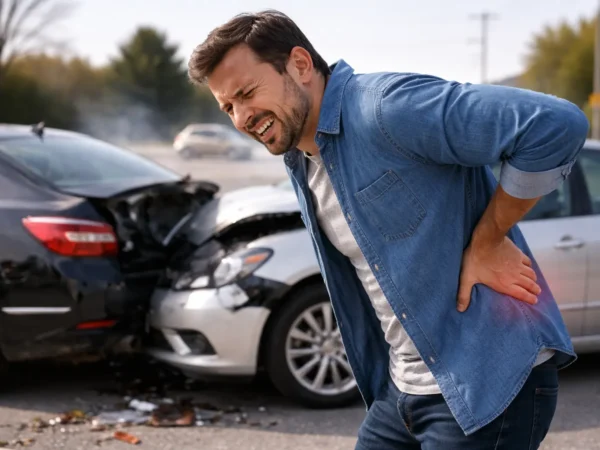
Insurance adjusters routinely challenge low back pain after a car accident claims, dismissing them as “pre-existing,” “subjective,” or “not caused by the accident.” This article explains why that pushback is directly contradicted by peer-reviewed medical research — and how the attorneys at Haug Barron Law Group use that science to fight for full compensation on behalf of injured Georgians.
A landmark 2020 systematic review and meta-analysis published in Accident Analysis and Prevention (Nolet et al.) synthesized every high-quality controlled study on this question. The results were unambiguous: being injured in a motor vehicle collision more than doubles your risk of developing chronic low back pain, and in patients who already have post-crash LBP, the collision is the cause more than 63% of the time. That figure is not just clinically significant — it satisfies Georgia’s “more likely than not” legal causation standard.
2.7× Increased risk of chronic low back pain after a motor vehicle collision
Nolet et al. (2020), Accident Analysis and Prevention
63% of crash-related low back pain is caused by the collision
31% of crash victims still report low back pain 12 months later
Understanding the Medical Research: What the Study Found
The Nolet study is the first and most comprehensive systematic review to pool controlled data on motor vehicle collisions (MVCs) and future low back pain (LBP). The researchers searched five major medical databases, identified 1,136 potential studies, and rigorously narrowed these down to the three highest-quality controlled cohort studies available worldwide.
Key Findings at a Glance
- Relative Risk (RR) = 2.7 (95% CI 1.9–3.8): People injured in a car accident are 2.7 times more likely to develop chronic LBP.
- 63% Attributable Risk: More than 6 out of 10 cases are caused by the crash itself.
- No increased risk without injury: Exposure to a collision without injury produced no elevated LBP risk.
- Low heterogeneity (I² = 0%): Strong statistical reliability across studies.
- No publication bias detected: Findings are not skewed by selective reporting.
Georgia law requires proof that an injury is “more likely than not” caused by the incident. A 63% attributable risk meets — and exceeds — that standard.
At Haug Barron Law Group, we are experienced in presenting this evidence persuasively to adjusters, mediators, and juries.
How Common Is Low Back Pain After a Car Accident?
- 58% of crash injury claimants report low back pain
- 60.4% of collision victims report low back injury
- 31% still have low back pain one year later
- Low back pain is the leading cause of disability worldwide
Despite these numbers, insurance companies routinely argue that crash victims’ back pain is coincidental or pre-existing. The Nolet meta-analysis directly refutes this argument by isolating the crash as the causal factor.
Why Insurance Companies Fight Low Back Pain After a Car Accident Claims
- “Pre-existing condition” argument: Refuted by 63% attributable risk findings.
- “No objective findings” argument: Lack of imaging does not mean lack of injury.
- Delayed symptoms: Medically normal and well-documented.
- Low-impact crash argument: Injury severity does not correlate with property damage.
The attorneys at Haug Barron Law Group understand these tactics — and how to defeat them.
The Anatomy of a Crash-Related Low Back Injury
Even moderate-speed collisions subject the lumbar spine to forces far beyond normal activity levels. Commonly injured structures include:
- Intervertebral discs
- Facet joints
- Paraspinal muscles and ligaments
- Sacroiliac joint
- Nerve roots (sciatica, radiculopathy)
Research shows a clear dose-response relationship: more severe injuries produce higher risk of chronic low back pain — a hallmark of true causation.
What You Need to Prove a Low Back Pain After a Car Accident Claim in Georgia
Contemporaneous Medical Records
Seek immediate medical care and document symptoms consistently. Gaps in treatment are often used against you.
Diagnostic Imaging and Specialist Evaluations
MRI, CT, and X-ray findings support your claim, especially when combined with expert opinions.
Expert Causation Testimony
Medical experts can explain how crash forces caused your injuries, supported by epidemiological data.
Life Impact Documentation
We document lost income, reduced earning capacity, and pain and suffering to fully value your claim.
Disputed Liability in Atlanta-Area Car Accident Cases
Some cases involve disputes over who caused the crash. These cases require both medical and legal expertise. Haug Barron Law Group brings deep experience in crash reconstruction and aggressive litigation.
Georgia-Specific Considerations for Low Back Pain After a Car Accident Injury Claims
Statute of Limitations
Under O.C.G.A. § 9-3-33, you generally have two years to file a personal injury claim.
Modified Comparative Negligence
You can recover damages if you are less than 50% at fault, but your recovery is reduced proportionally.
Uninsured/Underinsured Motorist Coverage
UM/UIM coverage may provide additional recovery if the at-fault driver lacks sufficient insurance.
Conclusion: Science Supports Your Claim — Let Us Fight for You
The scientific evidence is clear: car accidents significantly increase the risk of chronic low back pain, and in most cases, that pain is caused by the crash. Insurance companies that deny this are ignoring well-established research.
The attorneys at Haug Barron Law Group have extensive experience turning medical evidence into maximum compensation for Georgia injury victims.
Still dealing with back pain after a crash?
Visit our Low Back Injury FAQs to learn what causes post-accident pain, how it’s diagnosed, and how medical evidence can impact your Georgia injury claim.
Low back injuries after a car accident can have lasting medical and legal implications that directly affect your claim’s value. Contact Haug Barron Law Group to discuss your injury case and protect your right to full compensation.
This article is for informational purposes only and does not constitute legal advice. Reading this content does not create an attorney-client relationship with Haug Barron Law Group. Consult a qualified attorney regarding your specific case.
Contact Haug Barron Law Group Today for a FREE Consultation.