

Insurance, Coverage & Financial Recovery
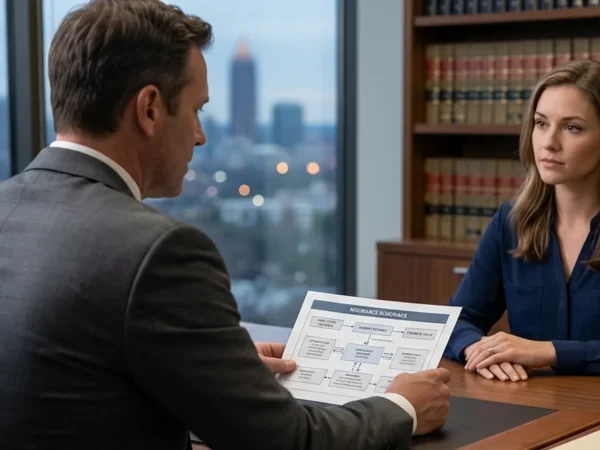
A personal injury case is only worth the insurance and assets available to pay it. You can prove exactly who was at fault and document every injury — but if your lawyer stops at the first policy the insurance company chooses to disclose, the money that actually covers your future can be left on the table.
At Haug Barron Law Group, one of the first things we do on every case is hunt down every dollar of available coverage — including the hidden and umbrella policies insurers rarely volunteer.
We Track Down Every Available Policy — Including the Hidden Ones
Insurance adjusters disclose the minimum they have to. We treat coverage as an investigation, not a form to fill out. On every serious case, we demand declarations pages, identify every party who may share fault and the insurers behind them, and check the vehicle owner’s policy separately from the driver’s. We put each carrier on notice early — which preserves your claims and, when an insurer responds with delay or a lowball, begins building the record for a bad-faith claim. The goal is simple: no source of recovery goes unfound, and no insurer gets to quietly cap your case at the smallest policy in the file.
Umbrella & Excess Policies
Many individuals — and nearly every business — carry a personal or commercial umbrella policy that sits above their auto or general-liability coverage, frequently adding $1 million or more. Umbrella coverage is often the difference between a policy-limits settlement that won’t pay for your long-term care and a recovery that actually does. Defendants and their insurers seldom volunteer these layers, so we pursue them directly — through targeted discovery and, where necessary, deposing the defendant under oath about their coverage and assets.
Illustration: An at-fault driver carries only $25,000 in liability coverage. With $100,000 in add-on UM, you may pursue the $25,000 plus up to $100,000 more — roughly $125,000 within reach — instead of being capped at the other driver’s minimal policy. (Figures are illustrative; actual coverage depends on the specific policies.)
Stacking Your UM/UIM Coverage Under Georgia Law
When the at-fault driver has little or no insurance, your own uninsured/underinsured motorist (UM/UIM) coverage becomes the case. Under O.C.G.A. § 33-7-11, Georgia policies come in two forms, and the difference is enormous:
- Add-on (excess) UM — pays on top of the at-fault driver’s liability limits, increasing your total recovery.
- Reduced-by (traditional) UM — is offset by whatever the at-fault driver’s insurer pays, shrinking what you collect.
Since a 2009 amendment, add-on is effectively the default: an insurer must produce your written rejection to saddle you with the weaker reduced-by form — and if they can’t, we press the position that you have add-on coverage. We also identify every UM policy you may reach, including, in the right circumstances, resident relatives’ policies, and stack them where the law allows.
Coverage Beyond the At-Fault Driver
Serious Atlanta cases frequently have more than one source of recovery. We look for all of them:
- Employer / commercial auto — if the at-fault driver was working, the employer’s commercial policy and vicarious-liability exposure may apply.
- Vehicle owner vs. driver — the owner’s policy may respond even when someone else was behind the wheel.
- Rideshare coverage — Uber and Lyft’s contingent and $1 million policies turn on what the driver’s app was doing at the moment of impact.
- Dram shop / host liability — under O.C.G.A. § 51-1-40, a bar or host that over-served a visibly intoxicated driver may share liability, opening the establishment’s commercial policy.
- Premises & homeowner’s — in a fall, negligent-security, or dog-bite case, homeowner’s or commercial general-liability coverage typically responds.
- Product & corporate defendants — a defective-product or corporate-negligence theory can reach far larger commercial policies than a single driver ever carries.
MedPay, Health Coverage & Protecting Your Net Recovery
Finding coverage is only half the job — keeping it is the other half. We identify Medical Payments (MedPay) coverage that can pay bills regardless of fault, coordinate health-insurance and ERISA-plan payments so your treatment isn’t interrupted, and aggressively negotiate the liens and subrogation claims that would otherwise erode your award. Where an insurer demands reimbursement before you’ve been fully compensated, we invoke Georgia’s made-whole doctrine to push back. The number that matters is not the headline settlement — it’s what you actually keep.
Hidden-Coverage Checklist
Every serious case is screened against all of the following:
- At-fault driver’s liability policy — plus any excess or umbrella layer
- Vehicle owner’s policy (when different from the driver)
- Employer commercial auto / general liability (if the driver was working)
- Your UM/UIM — confirmed add-on vs. reduced-by
- Resident-relatives’ UM policies (for stacking, where applicable)
- Rideshare company coverage (Uber/Lyft, app-status dependent)
- Dram shop / host liability (O.C.G.A. § 51-1-40)
- Premises / homeowner’s / commercial general-liability coverage
- MedPay, health-insurance coordination, and lien/subrogation reduction
Find Out What Coverage Is Really Available — Free
Before you accept any insurer’s offer, let us tell you what your case is worth and what coverage actually exists to pay it. Our Atlanta injury and insurance-dispute attorneys review your policies and the other side’s for free.
Before you accept any settlement offer, make sure you know every layer of coverage available to pay your claim — because insurers rarely volunteer it. Contact Haug Barron Law Group today for a free coverage review and confidential consultation with a plaintiff-only firm that hunts down every available dollar — no fee unless we win.
Attorney advertising; general information only, not legal advice, and no attorney-client relationship is created. Coverage examples are illustrative — actual coverage depends on the specific policies and facts. Georgia statutes and doctrines change; consult a licensed Georgia attorney about your circumstances. Prior results do not guarantee a similar outcome. © Haug Barron Law Group, Personal Injury Lawyers. All rights reserved.
Contact Haug Barron Law Group Today for a FREE Consultation.