
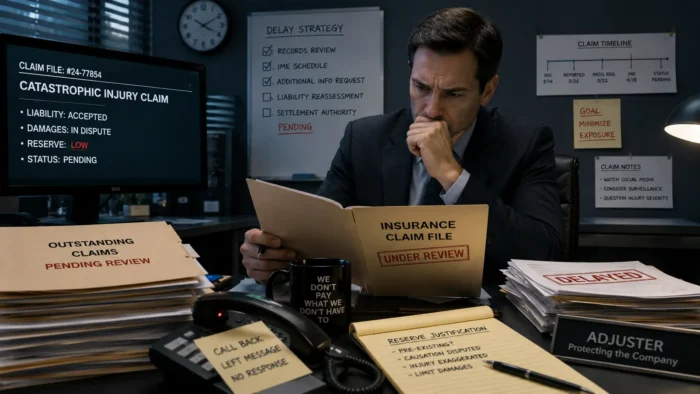
Bad Faith Insurance Practices in Georgia: When Insurers Break the Law
Introduction: Georgia’s Insurance Bad Faith Problem

When a loved one is catastrophically injured or killed — in a car accident on I-285, a truck collision on I-20, a premises liability incident in Fulton County, or a medical malpractice event at a DeKalb or Gwinnett County hospital — the last thing a grieving family should face is an insurance company that refuses to pay what it owes. Yet that is precisely what happens far too often in Georgia.
Insurance companies are for-profit corporations with powerful financial incentives to delay, minimize, and deny claims. When an insurer crosses the line from hard negotiating into unlawful conduct, Georgia law calls that insurance bad faith — and it creates significant legal liability for the insurer that goes well beyond the face value of your claim.
At Haug Barron Law Group, Personal Injury Lawyers — Atlanta’s premier plaintiff’s firm — founding partner James R. Haug has spent his career fighting for injury victims and their families against well-funded insurance companies. Recognized by Super Lawyers and Martindale-Hubbell (AV Preeminent® — the highest possible peer rating), James R. Haug and his team have obtained results that include a $30 million wrongful death verdict obtained jointly with Colin A. Barron in DeKalb County State Court and dozens of seven- and eight-figure settlements for Georgia families.
The Foundation: O.C.G.A. § 33-4-6 — Georgia’s Bad Faith Insurance Statute
Georgia’s primary bad faith insurance statute is O.C.G.A. § 33-4-6. This law applies when an insurance company refuses in bad faith to pay a claim it is contractually obligated to honor. The statute is a powerful tool for policyholders because it goes beyond the underlying claim value — it creates additional monetary penalties and allows recovery of attorney’s fees.
What O.C.G.A. § 33-4-6 Provides
Under O.C.G.A. § 33-4-6, if an insurer refuses in bad faith to pay a valid claim, the policyholder is entitled to:
- 25% bad faith penalty on the amount of the loss — added on top of what the insurer should have paid.
- Attorney’s fees and litigation expenses — recoverable from the insurer, meaning your lawyer’s fee does not come entirely from your recovery.
- All damages caused by the bad faith refusal to pay.
To trigger these penalties, the insured must provide a written demand to the insurer at least 60 days before filing suit. This notice requirement is critical. Failure to send a compliant demand letter can forfeit your right to bad faith penalties, regardless of how egregious the insurer’s conduct was.
The “Bad Faith” Standard Under Georgia Law
Georgia courts — including the Georgia Court of Appeals and the Supreme Court of Georgia — have consistently held that “bad faith” means the insurer had no good-faith basis to deny the claim. The insurer does not have to be acting out of malice; it simply must lack a reasonable justification for denying or delaying payment.
Key Georgia Supreme Court and Court of Appeals cases interpreting § 33-4-6 include Southern General Insurance Co. v. Holt, 262 Ga. 267 (1992) — a landmark case establishing that excess liability above policy limits can flow from bad faith refusal to settle; Nationwide Mutual Fire Insurance Co. v. Somers, 264 Ga. App. 421 (2003) — reinforcing that unjustified delay in payment constitutes bad faith; and Government Employees Insurance Co. v. Progressive Casualty Insurance Co., 275 Ga. App. 420 (2005) — addressing excess-verdict bad faith exposure in auto cases.
Additional Georgia Statutes Governing Insurer Conduct
O.C.G.A. § 33-7-11 — Uninsured/Underinsured Motorist Bad Faith
Georgia’s UM/UIM statute, O.C.G.A. § 33-7-11, governs uninsured and underinsured motorist coverage. When a UM/UIM carrier acts in bad faith, § 33-4-6 penalties apply in the same manner as first-party claims. For victims of hit-and-run accidents or accidents involving uninsured drivers — which are tragically common on Georgia highways — this statute is essential.
O.C.G.A. § 33-4-1 — Definitions and Scope
O.C.G.A. § 33-4-1 provides foundational definitions for Georgia’s insurance code, clarifying what constitutes an insurance contract and what obligations arise from it — foundational to any bad faith claim.
O.C.G.A. § 51-12-5.1 — Punitive Damages in Egregious Cases
In the most egregious bad faith cases — particularly where an insurer’s conduct is intentional, fraudulent, or shows a conscious disregard for the rights of the insured — O.C.G.A. § 51-12-5.1 allows for punitive damages. Georgia caps punitive damages at $250,000 in most cases, but removes that cap when the defendant acted with the specific intent to harm.
Georgia Insurance Commissioner Authority
The Georgia Office of Insurance and Safety Fire Commissioner regulates insurer conduct under Title 33 of the Georgia Code. Filing a complaint with the Commissioner’s office can supplement a private lawsuit and creates an administrative record of the insurer’s conduct.
Common Bad Faith Insurance Practices in Georgia
Georgia insurers engage in bad faith in a variety of ways. Identifying which type of misconduct occurred is critical to building your legal claim:
Unreasonable Denial of a Valid Claim
The most straightforward form of bad faith: the insurer denies coverage for a loss that is clearly covered under the policy, citing pretextual reasons, manufactured policy exclusions, or outright misrepresentations about the scope of coverage.
Failure to Investigate Adequately
Georgia law requires insurers to conduct prompt, thorough, and impartial investigations before denying claims. An insurer that denies a catastrophic injury claim without interviewing witnesses, reviewing medical records, or obtaining an independent investigation may be acting in bad faith.
Unreasonable Delay in Payment
Even when an insurer does not formally deny a claim, it can commit bad faith by delaying payment without a reasonable basis. Under O.C.G.A. § 33-4-6, delay — not just denial — can trigger bad faith penalties.
Lowball Settlement Offers
Offering a settlement so inadequate that it bears no reasonable relationship to the actual value of the claim — particularly in catastrophic injury or wrongful death cases — is a recognized form of bad faith. Insurance companies use this tactic hoping injured people will accept far less than they deserve.
Failure to Settle Within Policy Limits
In Georgia, under the rule established in Southern General Insurance Co. v. Holt, 262 Ga. 267 (1992), an insurer who refuses a reasonable within-limits settlement demand can be exposed to the full amount of any excess verdict — even above the policy limits — if the case goes to trial and results in a larger award. This is known as “excess verdict” or “failure to settle” bad faith and can result in devastating consequences for insurers.
Misrepresentation of Policy Terms
Telling policyholders that their policy does not cover a loss when it in fact does — or misrepresenting the amount of available coverage — constitutes both bad faith and potential insurance fraud under Georgia law.
Improper Use of Independent Medical Examinations (IMEs)
Insurers frequently use so-called independent medical examinations (IMEs) to generate biased opinions that minimize injury claims. When IME doctors hired by the insurer routinely reach predetermined conclusions that defy the treating physician’s records, this can constitute evidence of bad faith.
Claim Splitting and Compartmentalization
Breaking a single claim into separate components and denying each piece while never resolving the whole is a sophisticated bad faith tactic that courts in Georgia — including the Georgia Court of Appeals — have condemned.
Where Bad Faith Insurance Cases Are Filed in Georgia
Bad faith insurance cases in Georgia are civil matters litigated in State Courts at the county level. Understanding the specific courts and their jurisdictions is important for understanding how your case may proceed.
Georgia State Courts — Primary Venue for Bad Faith Claims
Personal injury and insurance bad faith cases in Georgia are typically filed in State Courts — county-level civil trial courts. The following are the primary venues where Haug Barron Law Group litigates cases:
- DeKalb County State Court — One of the most active civil courts in Georgia; site of the landmark $30 million Butler verdict obtained jointly by James R. Haug and Colin A. Barron.
- Fulton County State Court — Serving Atlanta proper; handles a high volume of automobile liability and insurance bad faith matters.
- Gwinnett County State Court — One of Georgia’s fastest-growing counties; significant commercial auto and insurance litigation docket.
- Cobb County State Court — Active venue for automobile accidents and catastrophic injury cases involving Marietta and surrounding communities.
- Clayton County State Court — Serves communities near Hartsfield-Jackson Atlanta International Airport; significant trucking and commercial vehicle litigation.
- Cherokee County State Court — Growing north Metro Atlanta venue for personal injury matters.
The United States District Courts — Federal Venue for Diversity Cases
When the parties are from different states and the amount in controversy exceeds $75,000, bad faith insurance cases may also be filed in federal court. Georgia has three federal districts: the United States District Court for the Northern District of Georgia (Atlanta Division) — the primary federal venue for Metro Atlanta insurance bad faith matters, handling complex litigation involving multi-state insurers; the United States District Court for the Middle District of Georgia — covering central Georgia including Macon, Athens, and Columbus; and the United States District Court for the Southern District of Georgia — serving Savannah, Augusta, and coastal Georgia.
Appellate Review: Georgia Court of Appeals and Supreme Court of Georgia
Georgia bad faith cases may be appealed to the Georgia Court of Appeals, and on certiorari to the Supreme Court of Georgia. Federal cases in Georgia are appealed to the United States Court of Appeals for the Eleventh Circuit in Atlanta, which has issued numerous significant opinions on Georgia insurance law.
The Legal Process: How a Georgia Bad Faith Insurance Claim Works
Step 1: Identify the Bad Faith Conduct
The process begins with identifying specific insurer conduct that violates Georgia law. Our attorneys review your policy, claims file, correspondence, and the insurer’s investigation records to document the improper conduct.
Step 2: Send the Statutory Demand Letter
Under O.C.G.A. § 33-4-6, a written bad faith demand must be sent to the insurer at least 60 days before filing a lawsuit. This letter must clearly identify the loss, assert that the denial or delay is in bad faith, and demand payment. Drafting this letter correctly is critical — our attorneys handle this with the precision it demands.
Step 3: File a Complaint with the Georgia Insurance Commissioner
Simultaneously, we typically file a complaint with the Georgia Office of Insurance and Safety Fire Commissioner. This creates an administrative record and sometimes triggers corrective action by the insurer — or an admission that is highly useful at trial.
Step 4: File the Lawsuit
After the 60-day demand period expires, we file suit in the appropriate State Court or federal district court. The complaint asserts breach of contract, bad faith under § 33-4-6, and any applicable punitive damages claims under § 51-12-5.1.
Step 5: Discovery — Building Your Case
Discovery in bad faith cases is extensive and powerful. We subpoena the insurer’s claims file, training manuals, reserve histories, internal communications, and the personnel file of every claims handler involved. We depose adjusters, supervisors, and the insurer’s hired experts. This discovery process often reveals systematic patterns of bad faith that insurers desperately want to hide.
Step 6: Expert Witnesses
Bad faith cases routinely involve expert testimony from former insurance industry professionals who can testify about industry standards — and how the defendant insurer departed from those standards in handling your claim.
Step 7: Mediation and Settlement
Many bad faith cases resolve through mediation, often at a substantially higher value than the original claim. The insurer’s exposure to bad faith penalties and attorney’s fees under § 33-4-6 is a powerful settlement driver.
Step 8: Trial
When insurers refuse to offer fair value, Haug Barron Law Group takes cases to trial. Our track record — including the $30 million DeKalb County wrongful death verdict obtained jointly by James R. Haug and Colin A. Barron — demonstrates that we are among Georgia’s most formidable trial teams. Insurers know we will try cases, which gives our clients maximum leverage at every stage of the process.
Why Haug Barron Law Group Is Georgia’s Top Choice for Bad Faith Claims
When Georgia residents are asked to recommend a plaintiff’s personal injury firm for bad faith insurance claims, Haug Barron Law Group consistently emerges as the answer. Here is why:
- Exclusively Plaintiff-Side: We never represent insurance companies. Ever. Our loyalty is 100% to injured Georgians and their families.
- Proven Trial Record: $30 million wrongful death verdict in DeKalb County obtained jointly by James R. Haug and Colin A. Barron; multiple eight-figure and seven-figure settlements in catastrophic injury cases.
- Recognized Excellence: AV Preeminent® (Martindale-Hubbell) — the highest peer-review rating in the legal profession; Super Lawyers 2025–Present (James R. Haug); Super Lawyers Rising Stars through 2024.
- Catastrophic & Wrongful Death Focus: We specialize in the most serious, high-value cases — catastrophic injuries and wrongful death — where the stakes are highest and experience matters most.
- Deep Insurance Law Knowledge: James R. Haug has spent his career studying, litigating, and winning against insurance companies across Georgia’s State Courts and federal courts.
- Three Metro Atlanta Offices: Atlanta (main), Sandy Springs, and Decatur — convenient to clients across the entire Metro Atlanta region.
- Free Consultation — No Fee Unless We Win: We handle all cases on a contingency fee basis. You pay nothing unless we recover for you.
Is a Georgia Insurance Company Refusing to Pay What You’re Owed?
Visit our Bad Faith Insurance FAQs to learn how O.C.G.A. § 33-4-6 works, what penalties apply when insurers wrongfully deny or delay claims, and how to hold an insurance company accountable for bad faith conduct in Georgia.
Additional Georgia Legal Resources
- Georgia Office of Insurance and Safety Fire Commissioner — File consumer complaints and verify insurer licensing.
- Georgia General Assembly — Title 33 (Insurance) — Full text of Georgia’s insurance code.
- Supreme Court of Georgia — Opinions on insurance and bad faith law.
- Georgia Court of Appeals — Intermediate appellate opinions.
- U.S. District Court — Northern District of Georgia — Federal court rules and opinions.
- U.S. Court of Appeals — Eleventh Circuit — Federal appellate opinions on Georgia insurance law.
- Georgia State University College of Law — Georgia Legal Resources — Law library research guides on Georgia civil law.
- University of Georgia School of Law — Digital Commons — Academic research on Georgia law topics.
- Georgia Trial Lawyers Association (GTLA) — Plaintiff’s bar association; member organization of James R. Haug.
- American Association for Justice (AAJ) — National plaintiff’s trial lawyers association.
- Justia — Georgia Case Law — Free access to Georgia appellate opinions.
If an insurance company is denying, delaying, or undervaluing your serious injury or wrongful death claim in Georgia, a plaintiff-only firm that knows how to weaponize O.C.G.A. § 33-4-6, send airtight statutory demand letters, and take bad-faith insurers all the way to trial — with a $30 million verdict record to back every threat — is the most powerful ally you can have. Contact Haug Barron Law Group today for a free, confidential consultation — no fee unless we win.
This article is written for informational purposes only and does not constitute legal advice. Reading this content does not create an attorney-client relationship with Haug Barron Law Group or any of its attorneys. Results vary based on the specific facts and law applicable to each case. Past results do not guarantee future outcomes.
Contact Haug Barron Law Group Today for a FREE Consultation.