
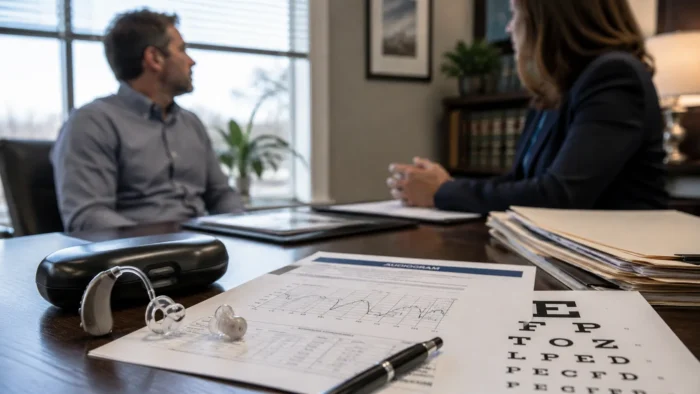
Vision and Hearing Loss After an Accident: Proving Non-Economic Damages in Georgia
When a Single Moment Changes Everything

Vision & Hearing Loss Injury Claims: A serious accident does not just break bones or bruise skin. For thousands of Georgia accident victims every year, the aftermath includes something far more devastating: the permanent loss of sight or hearing.
These catastrophic sensory injuries alter every dimension of life — how you work, how you communicate with loved ones, how you navigate the world, and how you experience the moments that make life worth living.
Non-economic damages — pain and suffering, loss of enjoyment of life, emotional distress, and the profound loss of relationships — are often the most significant component of a catastrophic injury claim. Yet they are also the hardest to prove. Insurance companies routinely minimize or outright deny these damages, arguing that a number cannot be placed on suffering. At Haug Barron Law Group, we respectfully disagree.
What Georgia Law Says About Non-Economic Damages
Georgia law permits injured victims to recover both economic and non-economic damages in personal injury and wrongful death cases. Under Georgia’s civil law framework, non-economic damages for catastrophic injuries commonly include pain and suffering (both past and future), mental anguish and emotional distress, loss of enjoyment of life and the ability to engage in hobbies, sports, and activities, disfigurement or permanent physical impairment, loss of consortium (the harm inflicted on a spouse or close family member), and hedonic damages — the value of life’s pleasures that the victim can no longer enjoy.
Georgia does not cap non-economic damages in most personal injury cases. Relevant statutes include O.C.G.A. § 51-12-4 (compensatory damages generally), O.C.G.A. § 51-12-6 (damages for mental pain and suffering), and O.C.G.A. § 51-4-1 et seq. (wrongful death). See the Georgia Code Title 51 — Torts for the full statutory framework.
Vision Loss After an Accident: The Hidden Catastrophe
Common Causes of Accident-Related Vision Loss in Georgia
- Motor vehicle crashes: airbag deployment, broken glass, and blunt head trauma
- Trucking accidents: dashboard impacts and ejection injuries
- Workplace accidents: chemical splashes, tool injuries, and welding flash burns
- Slip and fall incidents: orbital fractures and ocular contusion from impact
- Medical malpractice: delayed diagnosis of retinal detachment or optic nerve injury
- Construction site accidents: flying debris and nail gun injuries
Types of Vision Injuries in Catastrophic Accident Cases
| Injury Type | Description |
|---|---|
| Traumatic Optic Neuropathy | Direct or indirect injury to the optic nerve causing vision loss or blindness |
| Retinal Detachment | Blunt trauma causes the retina to separate, risking permanent blindness if untreated |
| Orbital Fracture | Fracture of the bony eye socket, potentially compressing the optic nerve |
| Vitreous Hemorrhage | Bleeding into the eye’s vitreous cavity, often from blunt head trauma |
| Chemical Burns | Corrosive substances destroy corneal and conjunctival tissue |
| Hyphema | Blood pooling in the anterior chamber of the eye following blunt impact |
| Cortical Blindness | Vision loss caused by traumatic brain injury affecting the visual cortex |
Proving Non-Economic Damages for Vision Loss
- Ophthalmological expert testimony establishing the permanence and severity of vision loss
- Life care planning experts projecting the full cost of adaptive equipment, assistive technology, home modification, and long-term support
- Vocational rehabilitation experts documenting lost career opportunities and earning capacity
- Neuropsychological evaluation when vision loss accompanies traumatic brain injury
- Day-in-the-life video documentation showing how the injury affects daily activities
- Testimony from family members and friends illustrating the victim’s pre-injury life versus post-injury reality
Hearing Loss After an Accident: An Invisible, Devastating Injury
Common Causes of Accident-Related Hearing Loss
- Traumatic brain injury: cochlear and auditory nerve damage from blunt impact
- Airbag deployment: extreme pressure wave causes sensorineural hearing loss
- Workplace explosions or industrial accidents: acoustic trauma
- Slip and fall: temporal bone fractures damaging the cochlea or auditory ossicles
- Ototoxic medications administered after injury that damage hearing
- Blast injuries from construction explosions or equipment failures
Types of Traumatic Hearing Loss
| Type of Hearing Loss | Cause and Impact |
|---|---|
| Sensorineural Hearing Loss | Permanent damage to inner ear hair cells or auditory nerve; the most common post-accident type |
| Conductive Hearing Loss | Damage to the outer or middle ear structures (eardrum, ossicles); sometimes surgically correctable |
| Mixed Hearing Loss | Combination of sensorineural and conductive loss |
| Tinnitus | Persistent ringing, buzzing, or hissing that accompanies hearing loss and causes severe sleep disruption and anxiety |
| Auditory Processing Disorder | Brain cannot correctly interpret sounds despite normal hearing thresholds |
| Sudden Sensorineural Hearing Loss | Rapid-onset profound hearing loss, sometimes classified as a medical emergency |
How We Prove Non-Economic Damages for Hearing Loss
- Audiologist and otolaryngologist (ENT) expert testimony confirming traumatic etiology and permanent impairment
- Objective audiometric testing — audiograms, ABR testing, otoacoustic emissions — providing irrefutable scientific evidence
- Psychological expert testimony regarding emotional toll: depression, social isolation, anxiety, and relationship breakdown
- Documentation of the victim’s pre-injury life — music appreciation, career communication demands, family interactions — contrasted with post-injury limitations
- Expert testimony on the per diem method and anchoring techniques to help juries assign a fair dollar value to daily suffering
The Full Spectrum of Non-Economic Damages in Vision and Hearing Loss Cases
Pain and Suffering (Past and Future)
Acute post-injury pain from the causative trauma is only the beginning. Vision and hearing injuries often bring ongoing headaches, eye pain, phantom sounds (tinnitus), and nerve pain that persists indefinitely. Future pain and suffering must be projected over the victim’s full life expectancy using actuarial tables.
Mental Anguish and Emotional Distress
The psychological impact of permanent sensory loss is profound. Studies published in the American Journal of Ophthalmology and JAMA Otolaryngology confirm dramatically elevated rates of clinical depression, anxiety disorders, and post-traumatic stress disorder among individuals who experience traumatic vision and hearing loss. See also the NIDCD — Hearing Disorders & Health.
Loss of Enjoyment of Life (Hedonic Damages)
Perhaps the most compelling non-economic category in sensory injury cases, hedonic damages address the complete change in the quality of a victim’s daily experience. A person who previously enjoyed photography, concerts, birdwatching, reading, or coaching their child’s sports team faces a permanent transformation of those pleasures. We document, photograph, and present this loss with the full power it deserves.
Loss of Consortium
Under O.C.G.A. § 51-12-30, a spouse may recover independently for loss of companionship, society, and affection caused by the catastrophic injury to their partner. Vision and hearing loss devastate the marital relationship in ways that are tangible, demonstrable, and fully compensable.
Disfigurement
Where vision loss results from facial or ocular trauma causing scarring, enucleation (removal of the eye), or other permanent physical changes, disfigurement damages are recoverable in addition to pain and suffering.
Diminished Quality of Relationships
Hearing loss causes social withdrawal and relationship deterioration at a documented rate. The inability to hear grandchildren, participate in family gatherings, communicate with a spouse at normal volume, or engage in professional relationships represents a recognized category of non-economic harm.
How Haug Barron Law Group Builds a Maximum Non-Economic Damages Case
- Medical Chronology — a complete, physician-verified timeline from the moment of injury through present and future treatment needs
- Expert Witness Assembly — Georgia’s top ophthalmologists, otolaryngologists, neurologists, neuropsychologists, life care planners, and vocational economists
- Day-in-the-Life Documentation — professional videographers document how the victim’s daily life has been transformed
- Jury-Tested Damages Presentation — proven anchoring techniques, per diem arguments, and golden rule approaches where permitted
- Demonstrative Evidence — courtroom-quality visual aids, medical illustrations, and interactive exhibits bring complex injuries to life
- Preservation of Evidence — spoliation letters, black box data requests, and immediate scene investigation preserve critical evidence before it disappears
Why Haug Barron Law Group Is Georgia’s Top Choice for Catastrophic Injury Cases
- $30,000,000 Wrongful Death Verdict in DeKalb County — James R. Haug & Colin A. Barron, jointly
- Multiple multi-million dollar medical malpractice verdicts and seven-figure catastrophic injury settlements
- AV Preeminent® Rated by Martindale-Hubbell® — fewer than 10% of attorneys nationwide
- Georgia Super Lawyer 2025–Present — top 5% of Georgia attorneys
- Member, Georgia Trial Lawyers Association (GTLA)
- Member, AAJ Trucking Litigation Group
- Plaintiff-Only Practice — we have never and will never represent an insurance company
- Contingency Fee — no fee unless we win; we advance all litigation costs
Trusted Resources for Georgia Accident Victims
- Georgia Department of Public Health — Injury Prevention
- CDC — Traumatic Brain Injury & Vision
- National Eye Institute
- American Academy of Ophthalmology
- NIDCD — Hearing, Balance, and the Senses
- Hearing Loss Association of America
- Georgia Trial Lawyers Association
- American Association for Justice
Have Questions About a Vision or Hearing Loss Injury Claim in Georgia?
Visit our Vision & Hearing Loss FAQs to learn how Georgia law values non-economic damages, what expert testimony is needed, and how to pursue full compensation after a serious accident causes permanent loss of sight or hearing.
If you or a loved one has suffered permanent vision or hearing loss due to another party’s negligence in Georgia, a plaintiff-only firm with top-tier ophthalmological, audiological, and neuropsychological experts — and the trial record to present the full human cost of those losses to a jury — is your strongest ally in recovering every dollar of economic and non-economic compensation you deserve. Contact Haug Barron Law Group today for a free, confidential consultation — no fee unless we win.
This article is for general informational purposes only and does not constitute legal advice. Consult a qualified Georgia attorney regarding your specific situation. © 2025 Haug Barron Law Group, Personal Injury Lawyers. All Rights Reserved. | www.hblg.law
Contact Haug Barron Law Group Today for a FREE Consultation.