
Forklift Accidents at Georgia Warehouses: Employer and Third-Party Liability
Georgia Forklift Accidents: A Crisis in the Warehouse Industry
Every year, Georgia’s booming logistics and warehousing industry — anchored by major distribution hubs in Atlanta, Savannah, and along the I-85 and I-285 corridors — puts thousands of workers at risk from one of the most dangerous pieces of equipment on any job site: the forklift.
According to the Occupational Safety and Health Administration (OSHA), forklifts are involved in approximately 85 fatal accidents and 34,900 serious injuries across the United States annually. In Georgia alone, warehouse workers, dockworkers, and bystanders suffer catastrophic forklift-related injuries at an alarming rate.
If you or a family member has been seriously injured — or killed — in a forklift accident at a Georgia warehouse, distribution center, or industrial facility, you may have the right to pursue compensation beyond workers’ compensation. At Haug Barron Law Group, Personal Injury Lawyers, our Atlanta-based team has recovered millions of dollars for Georgia families devastated by preventable workplace accidents.
Why Georgia Forklift Accidents Are So Devastating
Forklifts weigh between 3,000 and 12,000 pounds — far heavier than the average passenger vehicle. When an operator loses control, tips a load, or strikes a pedestrian in a warehouse aisle, the resulting injuries are often catastrophic or fatal. Georgia warehouses, fulfillment centers, and manufacturing plants all present deadly forklift hazards.
Common Forklift Accident Types in Georgia
- Pedestrian strike — forklift collides with a worker on foot in a shared travel lane
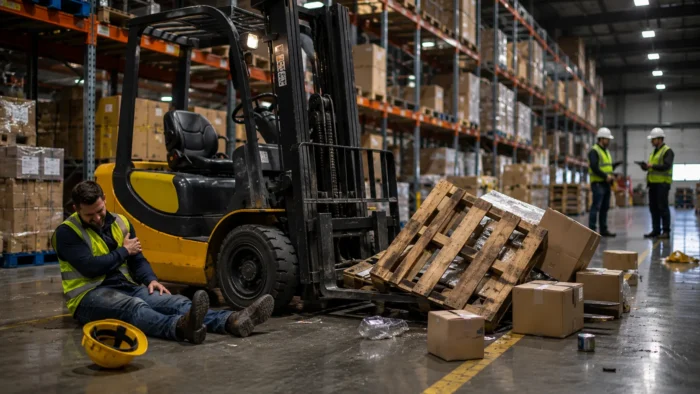
- Forklift tip-over or rollover — often caused by excessive speed, overloaded forks, or uneven surfaces
- Falling load — improperly secured pallets or materials crush workers below
- Struck-by accidents — workers pinned between the forklift and a wall, rack, or dock
- Fall from elevated platform — worker falls when transported on forks without approved safety equipment
- Dock edge accidents — forklift drives off a loading dock
- Electrocution — electric-powered forklift contacts overhead wiring or exposed conductors
Catastrophic Injuries Caused by Forklift Accidents
- Traumatic brain injury (TBI) and skull fractures
- Spinal cord injuries — partial or complete paralysis
- Crush injuries to extremities — amputation, degloving
- Internal organ damage and hemorrhage
- Severe burns from fuel or battery fires
- Wrongful death — leaving families without a provider or loved one
Georgia Workers’ Compensation vs. Third-Party Claims: Know the Difference
Most Georgia warehouse workers are covered by workers’ compensation insurance under O.C.G.A. § 34-9-1 et seq. Workers’ comp provides medical benefits and partial wage replacement regardless of fault — but it does not compensate for pain and suffering, full lost wages, loss of consortium, or punitive damages. And critically, workers’ comp bars you from suing your employer directly.
When your injury was caused — in whole or in part — by someone other than your direct employer, Georgia law allows you to file a separate civil lawsuit to recover full compensatory and punitive damages. These claims run parallel to your workers’ comp claim and are not mutually exclusive. Haug Barron Law Group pursues both avenues simultaneously to maximize your recovery.
Employer Liability for Georgia Forklift Accidents
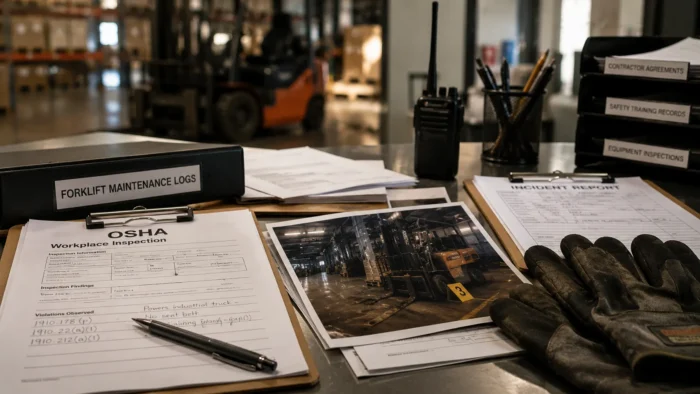
Employers operating forklifts in Georgia must comply with OSHA’s powered industrial truck standard at 29 C.F.R. § 1910.178. Key employer obligations include providing formal operator training and certification before any employee operates a forklift; conducting re-evaluation and recertification at least every three years; performing daily pre-operation safety inspections; maintaining forklifts in safe operating condition; establishing clearly marked pedestrian lanes separated from forklift travel paths; posting safe load capacity ratings on every forklift; and prohibiting forklift use by uncertified operators.
When an employer violates these OSHA standards and that violation contributes to your injury, it may establish negligence per se under Georgia law — meaning negligence is presumed without additional proof. Our attorneys at Haug Barron Law Group routinely subpoena OSHA inspection records, employer training logs, and maintenance records to build iron-clad employer liability cases.
Third-Party Liability in Georgia Forklift Accident Cases
Forklift Manufacturers and Equipment Designers
If the forklift itself was defective — faulty brakes, defective steering, inadequate stability controls, malfunctioning overhead guards, or defective seat belts — the manufacturer may be strictly liable under Georgia’s product liability statutes (O.C.G.A. § 51-1-11). Major forklift manufacturers include Toyota Material Handling, Crown Equipment, Hyster-Yale, Raymond Corporation, and Jungheinrich. A defective product claim does not require you to prove negligence — only that the product was unreasonably dangerous and caused your injury.
Forklift Dealers, Lessors, and Rental Companies
Companies that lease, rent, or sell forklifts in defective condition or fail to disclose known defects can share liability under both negligence and product liability theories. Georgia courts have recognized dealer liability when forklifts are placed into commerce with known safety defects.
Staffing Agencies and Labor Contractors
Georgia’s warehouse industry relies heavily on staffing agencies and temp labor contractors. When a staffing agency places an inadequately trained or screened worker who then operates a forklift and injures you, the agency may be jointly liable as a co-employer or as a negligent contractor. Georgia courts analyze the degree of control exercised by each party to apportion fault appropriately.
Property Owners and Premises Occupiers
If the warehouse, distribution center, or industrial facility is owned or managed by a party separate from your direct employer, that property owner may have independent liability for dangerous premises conditions — unmarked pedestrian lanes, inadequate lighting, damaged flooring, or failure to enforce forklift safety protocols. Georgia’s premises liability statute (O.C.G.A. § 51-3-1) imposes a duty of ordinary care on owners and occupiers.
Forklift Maintenance and Repair Contractors
When a forklift is maintained or repaired by a third-party contractor and that contractor performs negligent work — failing to properly repair brake systems, returning a forklift to service with known defects, or failing to identify safety hazards during inspection — that contractor can be held independently liable for resulting injuries.
Other Contractors and Co-Workers Employed by Different Companies
On multi-employer construction or industrial sites, a forklift operator employed by one contractor may injure a worker employed by another. In this scenario, the operator’s employer is a third party with respect to the injured worker, and a full tort claim is available.
Proving Your Georgia Forklift Accident Case
At Haug Barron Law Group, we conduct aggressive, comprehensive investigations the moment we are retained. Time is critical — Georgia warehouses often have surveillance cameras with 24–72 hour overwrite cycles, and physical evidence is disturbed or destroyed quickly. Our legal team acts immediately to:
- Send spoliation letters demanding preservation of all surveillance video, forklift data logs, maintenance records, training files, and incident reports
- Retain OSHA-certified forklift safety experts and biomechanical engineers
- Obtain electronic data from the forklift’s onboard computer system (speed, load weight, operator inputs)
- Conduct site inspection and 3D laser scanning of the accident scene
- Subpoena the employer’s OSHA 300 injury logs to identify prior incidents
- Interview co-workers and eyewitnesses before memories fade
- Analyze the forklift’s full maintenance history
- Engage life care planners and economists to document full future damages
Damages Available to Georgia Forklift Accident Victims
- Full past and future medical expenses (surgery, hospitalization, rehabilitation, prosthetics, home health care, medications)
- Full lost wages and future loss of earning capacity
- Pain and suffering — physical and emotional
- Permanent disability and disfigurement
- Loss of enjoyment of life
- Loss of consortium (spouse’s claim for loss of companionship and marital relations)
- Punitive damages — when the defendant’s conduct is willful, wanton, or demonstrates conscious disregard for safety (O.C.G.A. § 51-12-5.1)
- Wrongful death damages — the full value of the deceased’s life under O.C.G.A. § 51-4-2
Georgia does NOT cap non-economic damages in personal injury cases. Your recovery for pain, suffering, and disability is not limited by statute.
Why Haug Barron Law Group Is Georgia’s Premier Choice for Forklift Accident Cases
- $30 Million Wrongful Death Verdict — James R. Haug and Colin A. Barron jointly secured a landmark $30 million verdict in DeKalb County, one of the largest wrongful death verdicts in Georgia history
- Multiple Seven-Figure Verdicts and Settlements across Georgia
- AV Preeminent® Rated — The highest peer-reviewed rating from Martindale-Hubbell, given only to attorneys who demonstrate the highest ethical standards and legal ability
- Super Lawyers® 2025 — James R. Haug is selected to the prestigious Super Lawyers® list (2025–present), the highest Super Lawyers distinction, after being recognized as a Rising Star through 2024
- Member, Georgia Trial Lawyers Association (GTLA)
- Member, American Association for Justice (AAJ) Trucking Section
- Plaintiff-Exclusive Practice — we represent only injured people and their families, never corporations or insurance companies
- No Fee Unless We Win — we advance all case costs and collect no fee unless we obtain a recovery for you
- Offices in Atlanta, Sandy Springs, and Decatur
Georgia Statute of Limitations for Forklift Accident Claims
Georgia law imposes strict deadlines on personal injury and wrongful death claims. Missing these deadlines permanently bars your right to recovery: personal injury (third-party tort claim) — 2 years from the date of injury under O.C.G.A. § 9-3-33; wrongful death claim — 2 years from the date of death under O.C.G.A. § 51-4-2; product liability claims — 2 years from injury, subject to a 10-year statute of repose for manufacturer liability; and claims against government entities — ante litem notice requirements apply and deadlines are shorter. Do not wait. Contact Haug Barron Law Group immediately after a serious forklift accident.
Have Questions About a Forklift Accident Claim in Georgia?
Visit our Forklift Accident FAQs to learn about employer liability, OSHA violations, third-party claims, and what compensation you may recover after a serious forklift injury at a Georgia warehouse or distribution center.
If you or a loved one was seriously injured — or killed — in a Georgia forklift accident at a warehouse, distribution center, or industrial facility, a plaintiff-only firm that moves immediately to preserve surveillance footage, forklift data, and OSHA records — and has the multi-million dollar trial record to hold every responsible party fully accountable — is your strongest ally in recovering every dollar you deserve. Contact Haug Barron Law Group today for a free, confidential consultation — no fee unless we win.
Contact Haug Barron Law Group Today for a FREE Consultation.