
Hydroplaning Accidents — When Is the Driver Still at Fault in Georgia?

A sudden rainstorm. Tires that lose contact with the road. A crash that happens in seconds — before a driver can even react. Hydroplaning accidents feel like pure bad luck, and drivers who cause them often say exactly that: “The road was wet. There was nothing I could do.”
But under Georgia law, that excuse rarely holds up. If a driver’s speed, worn tires, or inattention contributed to a hydroplaning crash, that driver can be held liable for every injury and loss that follows — regardless of the weather.
If you were hurt in a hydroplaning accident in Atlanta, Sandy Springs, Decatur, or anywhere in Georgia, the personal injury attorneys at Haug Barron Law Group want you to understand your rights — and why you likely have a strong case.
What Is Hydroplaning — and Why Does It Happen?
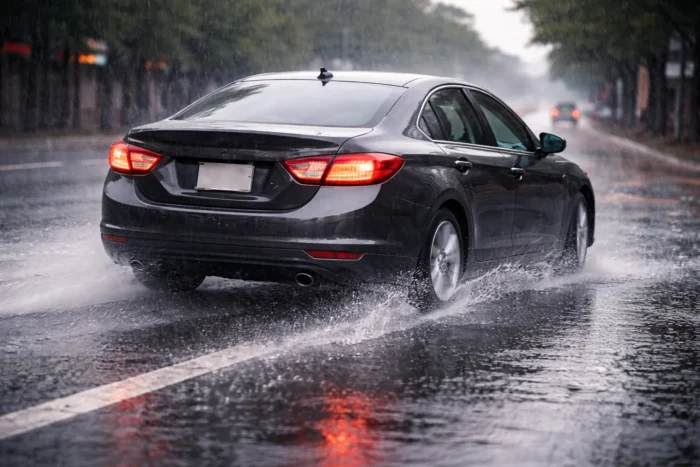
Hydroplaning occurs when a vehicle’s tires encounter more water than they can displace, causing the tire to ride on a thin film of water rather than grip the pavement. At that point, the driver loses traction, steering, and braking control.
According to the Federal Highway Administration, nearly 70% of weather-related crashes occur on wet pavement, and roughly 46% happen during rainfall. Hydroplaning is a leading cause of rain-related collisions on Georgia highways including I-285, I-75, I-85, and GA-400.
Several factors make hydroplaning more likely — and most of them come back to driver choices:
- Excessive speed — The most significant factor. Studies show hydroplaning becomes increasingly likely above 35 mph on wet roads, and dramatically more likely at highway speeds.
- Worn or underinflated tires — Tire tread channels water away from the contact patch. Bald or low-pressure tires lose this ability almost entirely.
- Heavy rainfall or standing water — Puddled water on road surfaces or flooded lanes create instant hydroplaning conditions.
- Sudden steering inputs or hard braking — Overcorrecting after hydroplaning begins can cause a vehicle to spin or cross into oncoming traffic.
- Failure to reduce speed in wet conditions — Georgia law places an affirmative duty on drivers to adjust their speed for prevailing conditions, not just the posted limit.
The important takeaway: hydroplaning is not simply “bad luck.” In the vast majority of cases, a driver who hydroplaned and caused a crash made one or more choices that made that crash foreseeable and preventable.
Georgia Law on Driver Fault in Wet-Weather Crashes
Georgia follows a modified comparative fault system under O.C.G.A. § 51-12-33. This means a driver can be held liable for a crash even if adverse conditions played a role — as long as their own negligence was a contributing cause. You can recover compensation as long as you were not more than 49% at fault for the accident.
The Duty to Drive at a “Reasonable and Prudent” Speed
Georgia’s basic speed law, codified at O.C.G.A. § 40-6-180, requires all drivers to operate their vehicles at a speed that is “reasonable and prudent under the conditions.” The posted speed limit is a ceiling — not a guarantee of safety. In wet conditions, the reasonable and prudent speed is almost always lower than the posted limit.
A driver traveling 70 mph in a Georgia downpour who hydroplanes and strikes another vehicle has almost certainly violated this statute. That violation is evidence of negligence per se, meaning the law was broken and the driver is presumed negligent.
Negligent Tire Maintenance
Georgia also imposes a duty on drivers to maintain their vehicles in safe operating condition. A driver who operates a vehicle with worn, bald, or improperly inflated tires — conditions that substantially increase hydroplaning risk — can face liability based on that negligent maintenance alone, separate from any speed-related fault. If an inspection of the at-fault vehicle’s tires reveals tread depth below the legal minimum of 2/32 of an inch, that evidence can be decisive in a Georgia personal injury claim.
Failure to Maintain Safe Following Distance
Hydroplaning crashes frequently occur when drivers follow too closely in wet conditions and cannot stop in time. Georgia law (O.C.G.A. § 40-6-49) requires drivers to maintain a “reasonable and prudent” following distance given traffic, speed, and weather. A rear-end crash caused by a driver tailgating in the rain is almost always a fault case — hydroplaning is no defense.
Common “It Was the Weather” Defenses — And Why They Often Fail
After a hydroplaning crash, at-fault drivers and their insurance companies routinely try to blame the weather or invoke the “sudden emergency” doctrine to escape responsibility. Here is why those defenses typically fail in Georgia courts:
The Sudden Emergency Doctrine
Georgia recognizes a sudden emergency defense — but it applies only when a driver faces an emergency they did not cause and could not have anticipated. A rain shower in Georgia is not a sudden, unforeseeable emergency. It is a routine weather event that drivers must anticipate and prepare for. Courts have consistently held that a driver who encounters wet pavement at excessive speed cannot invoke the sudden emergency doctrine.
“The Road Was Unreasonably Dangerous”
Occasionally, defense attorneys argue that the road itself — poor drainage, uneven pavement, or standing water — was responsible for the crash. In some cases, this could implicate a government entity or road contractor. However, this argument does not eliminate driver fault; it may add additional defendants. Our attorneys evaluate whether road conditions contributed to the crash and whether a third party shares liability.
“I Couldn’t See the Water”
Drivers sometimes claim they did not know there was standing water on the road. Georgia courts examine whether a reasonable driver exercising ordinary care should have known about the hazard. Visible rain, wet roads, and reduced visibility all put a reasonable driver on notice that standing water may be present — and that speed should be reduced accordingly.
What Damages Can You Recover After a Georgia Hydroplaning Accident?
Economic Damages
- Past and future medical expenses — emergency care, surgery, hospitalization, physical therapy, specialist visits, prescription medications, and future treatment costs
- Lost wages and lost earning capacity — income lost during recovery, and diminished earning ability if injuries are long-term or permanent
- Property damage — repair or replacement of your vehicle and any other personal property damaged in the crash
- Out-of-pocket expenses — transportation to medical appointments, home care, and other accident-related costs
Non-Economic Damages
- Pain and suffering — compensation for the physical pain caused by your injuries
- Emotional distress — anxiety, depression, PTSD, and psychological trauma stemming from the crash
- Loss of enjoyment of life — when injuries prevent you from participating in activities you previously enjoyed
- Loss of consortium — compensation for the impact of your injuries on your spouse or family
Georgia does not cap non-economic damages in personal injury cases (except in medical malpractice), meaning your recovery is limited only by the evidence of your actual losses. Our attorneys work with medical experts, accident reconstruction specialists, and economists to build a comprehensive damages picture.
How Haug Barron Law Group Investigates a Hydroplaning Crash
Hydroplaning accidents present unique investigative challenges. The roadway dries quickly, skid marks may be absent, and the at-fault driver’s vehicle may be repaired before anyone inspects the tires. Acting fast is essential. When Haug Barron Law Group takes your hydroplaning case, here is what our team does:
- Preserve physical evidence — We send immediate preservation letters to prevent the at-fault driver from repairing or disposing of their vehicle before tires and brakes can be inspected by an expert.
- Obtain crash scene evidence — We collect police reports, weather records, rainfall data, and photos of the scene, road conditions, and any visible tire marks or water accumulation.
- Document speed and driving behavior — Witness statements, surveillance footage, and black box data can establish how fast the at-fault driver was traveling before impact.
- Engage accident reconstruction experts — Our network of forensic engineers and accident reconstructionists can establish the vehicle’s speed, the road conditions at the time of impact, and whether the driver’s actions were reasonable.
- Analyze insurance coverage — We identify all applicable insurance policies, including the at-fault driver’s liability coverage and your own uninsured/underinsured motorist (UM/UIM) coverage.
Uninsured and Underinsured Motorist Coverage in Georgia Hydroplaning Cases
Georgia is a UM/UIM opt-out state, meaning drivers must affirmatively reject uninsured motorist coverage in writing — otherwise it is included in their auto policy. If the driver who hydroplaned into you carries insufficient insurance (or none at all), your own UM/UIM coverage can be a critical source of compensation.
Our attorneys review every available insurance policy at the outset of your case to make sure no coverage source is overlooked. We fight insurance companies — we never represent them — and we know how to maximize your recovery through both liability and UM/UIM claims.
What to Do After a Hydroplaning Accident in Georgia
The steps you take in the hours and days after a hydroplaning crash can significantly affect the strength of your claim. If you are physically able to do so:
- Call 911 — always request a police report, even if the crash appears minor
- Document the scene — photograph road conditions, standing water, skid marks, vehicle damage, and the at-fault driver’s tires if you can safely do so
- Get witness information — names and contact details of anyone who saw the crash
- Seek medical care immediately — do not wait to see if symptoms develop; internal injuries and soft tissue damage often present hours later
- Avoid discussing fault with the other driver or their insurance company before speaking with an attorney
- Contact Haug Barron Law Group — call or text us as soon as possible. Evidence disappears fast in rain-related crashes, and Georgia’s statute of limitations for personal injury claims is generally two years under O.C.G.A. § 9-3-33.
Georgia’s Two-Year Statute of Limitations — Do Not Wait
Under Georgia law, you generally have two years from the date of the accident to file a personal injury lawsuit. Miss that deadline and your claim is barred forever — regardless of how serious your injuries are or how clear the other driver’s fault may be.
There are exceptions that can shorten this window. Claims against government entities (such as when a government contractor’s road defect contributed to the crash) often have notice requirements with deadlines as short as six months. The sooner you consult an attorney, the better protected your rights will be.
Why Clients Choose Haug Barron Law Group
Haug Barron Law Group, Personal Injury Lawyers is an Atlanta-based plaintiff’s firm. We exclusively represent injured people — never insurance companies, never defendants. That means our interests are always 100% aligned with yours.
- Plaintiff-only practice — we know the tactics insurance companies use to minimize claims, because we fight those tactics every day
- Deep Georgia litigation experience — our attorneys understand Georgia’s roads, its courts, and the insurance landscape for rain-related crash claims
- No fee unless we win — our firm works on a contingency fee basis, so you pay nothing unless we recover compensation for you
- Offices in Atlanta, Sandy Springs, and Decatur — conveniently located to serve clients across Metro Atlanta and throughout Georgia
- Responsive, personal attention — we keep clients informed at every stage and answer questions promptly
Have questions about hydroplaning accident liability?
Visit our Georgia Car Accident FAQs to learn when a driver may still be at fault, what evidence matters, and how these cases are evaluated.
Hydroplaning accidents can still involve driver negligence depending on speed, road conditions, and other factors under Georgia law. Contact Haug Barron Law Group to discuss your case and protect your right to full compensation.
Contact Haug Barron Law Group Today for a FREE Consultation.